Tennis for Two, or the physicist who didn't notice what he'd done
On October 18, 1958, in a gymnasium at Brookhaven National Laboratory on Long Island, a line of visitors snaked out the door and down the hall. They were waiting to play a dot.
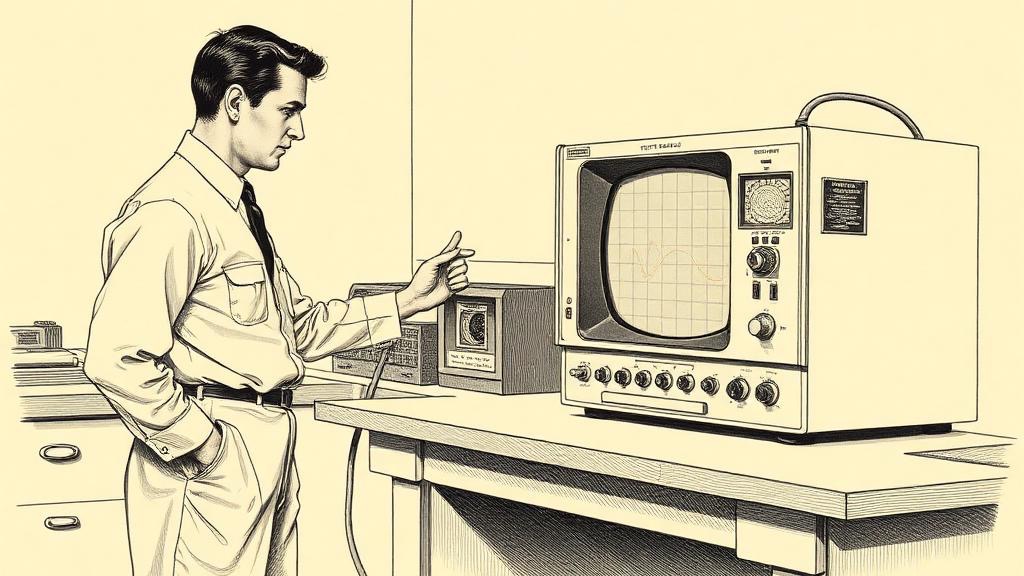
The dot — a point of green phosphor light on the face of a 5-inch DuMont oscilloscope — bounced across a horizontal line standing in for a net. Players gripped aluminum controllers and twisted a knob to aim, then jabbed a button to serve. The ball arced under simulated gravity, hit the ground, bounced, and crossed or didn’t. The game was called Tennis for Two, and the man who built it in three weeks on the side was William Higinbotham: nuclear physicist, Manhattan Project veteran, and founding chairman of the Federation of American Scientists.
Higinbotham’s day job at Brookhaven was running the instrumentation division — designing circuitry, building detectors, keeping the lab’s machines calibrated. The annual Visitor’s Day open house was a diplomatic exercise: the federal government wanted the public to feel good about nuclear science, and the usual display of static posters and inert equipment was not accomplishing that. Higinbotham, paging through the manual for the lab’s Donner Model 30 analog computer, noticed it could simulate a bouncing ball with wind resistance. He assembled four operational amplifiers for ball motion, six for collision detection, a pair of controllers, and an oscilloscope. The whole thing cost roughly nothing beyond his own time.
Hundreds of visitors queued to play it. The game ran at 36 hertz — smooth enough to look like motion, startling enough to stop people in their tracks. The following year, Higinbotham rebuilt it with a larger oscilloscope and added a selector switch: players could change the simulated gravity to lunar or Jovian. On the moon setting, the ball drifted in long slow arcs. On Jupiter, it slammed into the floor almost instantly.
Here is the detail that could make a patent lawyer weep. Higinbotham never filed a patent. After the 1959 Visitor’s Day, the equipment — a federally funded oscilloscope and an analog computer, not officially authorized for public entertainment — was quietly disassembled and the components returned to laboratory work. Higinbotham himself didn’t think Tennis for Two was novel: bouncing-ball circuits already existed, he said, and all he had done was give one a net and a pair of controllers. When Creative Computing magazine called him the “Grandfather of Video Games” in 1982, he seemed genuinely puzzled. He had spent most of the previous decade testifying before Congress about nuclear non-proliferation, which he considered the more important legacy.
He had a point. Higinbotham helped draft the first Atoms for Peace legislation and argued for most of his life that physicists bore a special responsibility for the weapons they had helped create. Tennis for Two was an afternoon project. The Federation of American Scientists was a life’s work.
What the game gave the world was not a design — it was dismantled, never patented, and had to be reconstructed from lab notebooks forty years later by a team of Brookhaven physicists tracking down vintage analog components. What it gave was a proof of a different kind of public experience: not graduate students, not soldiers at a base exhibition in Tokyo, but civilians on a family outing, who queued up, took a controller, and played an electronic game. They interacted with a machine that responded. That was new.
The oscilloscope held fifteen years of radar research, atomic physics, and analog signal processing — and pointed it at a ball bouncing over a net. The games that followed pointed it at everything else.
Sources
- The First Video Game? — Brookhaven National Laboratory — first-person account from BNL, technical specs of the Donner computer and oscilloscope, the visitors’ day context, why it was dismantled.
- Following the Bouncing Ball: Tennis for Two at The Strong — The Strong National Museum of Play — Higinbotham’s Manhattan Project background, visitor crowds, the 1997 reconstruction effort, and the “Grandfather of Video Games” designation.
- Tennis for Two — Wikipedia — technical breakdown (DuMont oscilloscope, Donner Model 30 analog computer, 36 Hz refresh, Jovian/lunar gravity variants in 1959).