Spacewar!, or the game no one thought to sell
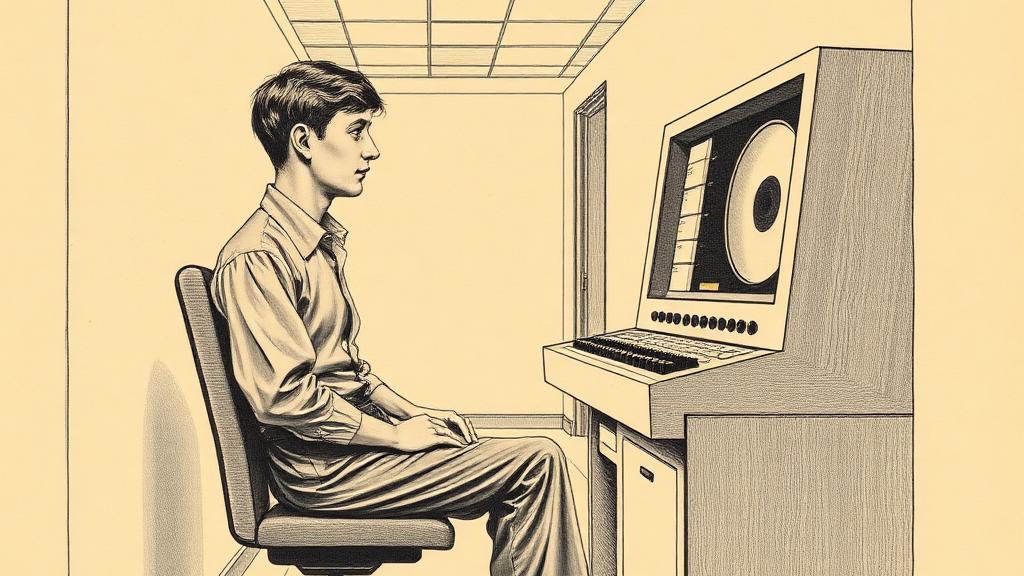
On the afternoon of Saturday, April 28, 1962, parents filed into MIT’s Building 26 for a weekend open house and found something unexpected on a cathode-ray tube display: two tiny spaceships circling each other while gravity dragged them toward a bright, flickering star in the center of the screen. One ship fired a torpedo. The audience watched to see who would survive. Nobody, by all accounts, asked what the machine had cost.
The machine — a PDP-1, one of only 53 ever manufactured — had cost roughly $120,000, or about $1.3 million today. Digital Equipment Corporation had delivered it to campus in late 1961 with no software, no manual for what to do with it, and no restriction on what MIT’s programmers might attempt. They had maybe six months before formal research claimed the machine. The hackers — a word they used proudly — decided to build a game.
The concept had been taking shape since the summer of 1961 among three MIT programmers: Steve Russell, Martin Graetz, and Wayne Wiitanen. Wiitanen was recalled by the Army Reserve before the first line of code was written. The project survived. Three design principles guided it: use every resource the machine has; stay consistently interesting; and, above all, be entertaining. The last rule was not negotiable.
What Russell built through the winter of 1961–62 was the first real-time interactive simulation with genuine competitive play. Two ships, called “the needle” and “the wedge,” could rotate, thrust, and fire torpedoes at each other. A gravitational field pulled everything toward the central star. Trajectories curved. You could slingshot around the star or fall into it. The PDP-1 was sending more than twenty thousand display points per second to keep the simulation running. In March 1962, MIT programmer Peter Samson added a star-field background built from actual nautical almanac data — every star between 22.5° north and 22.5° south, rendered at its correct relative brightness, scrolling in real time. Samson called the subroutine the “Expensive Planetarium,” a small joke about the machine’s price tag.
Getting Russell to write any of it had required what can only be described as aggressive customer service. He stalled for months, citing missing trigonometric subroutines. MIT’s Alan Kotok called Digital Equipment directly, learned the routines already existed on tape, drove to DEC’s offices, and deposited the tape in front of Russell without ceremony. “I looked around,” Russell later recalled, “and I didn’t find an excuse, so I had to settle down and do some figuring.”
Spacewar! was never sold. Russell gave it away. The programmers who spread out to Stanford, DEC, and other universities in 1962 carried copies on magnetic tape; within a decade it had been ported to more than a dozen different computer models. Nolan Bushnell played it at the University of Utah and spent the next few years trying to build a version cheap enough for an arcade — a project that yielded Computer Space in 1971 and, the year after that, Pong. The commercial video game industry was built, in large measure, by people who had first encountered the medium for free.
Russell never thought to patent it. The industry that grew up selling games was invented, largely, by people who had first learned what they were missing while playing his.
Sources
- Spacewar! — Wikipedia — core history, creators’ roles, timeline, Kotok anecdote, spread across platforms.
- PDP-1 Spacewar — Computer History Museum — machine specifications, context of the PDP-1’s arrival at MIT, significance to hacker culture.
- “The Origin of Spacewar” by J.M. Graetz — Masswerk — Martin Graetz’s first-hand account of the design process, the Expensive Planetarium, and the three design principles.