OXO, or the video game that Cambridge kept to itself
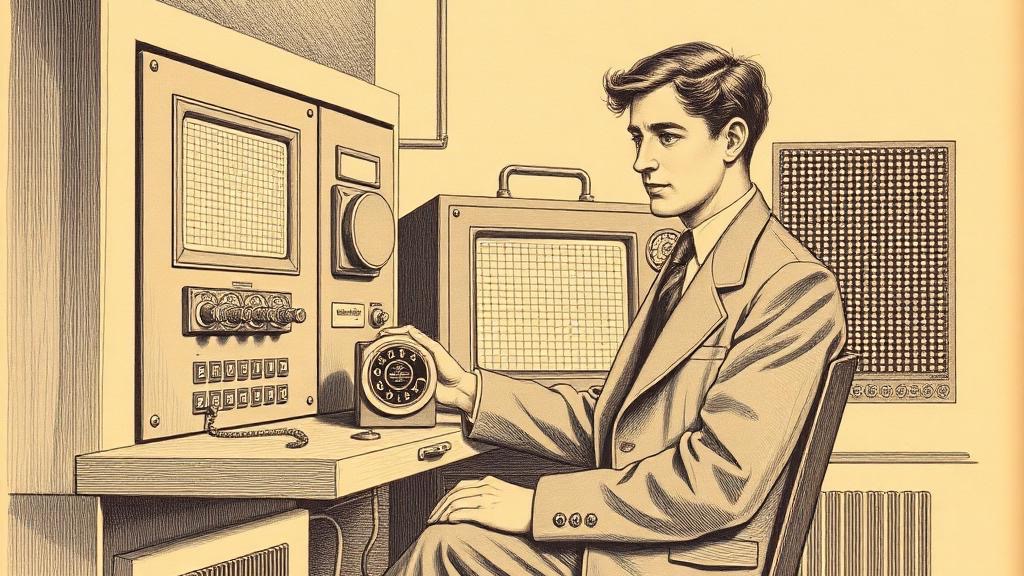
In the Mathematical Laboratory at Cambridge in 1952, the EDSAC filled a room the size of a small gymnasium with racks of vacuum tubes, mercury delay lines, and the low hum of several kilowatts turning into arithmetic. Into this cathedral of postwar computation, a 30-year-old doctoral student named Alexander Shafto Douglas — Sandy, to everyone — wired a rotary telephone dial and made the machine play noughts and crosses.
The context matters. Douglas was writing a thesis on human-computer interaction at a time when “interaction” meant feeding a deck of punch cards into a slot, walking away, and returning the next morning to collect a printout. He wanted to demonstrate something different: that a computer could display a game state on a screen, accept input from a human, and respond. He chose noughts and crosses because it was simple enough to program on 1952 hardware and interesting enough to prove the point.
He repurposed one of the EDSAC’s three cathode-ray tube screens — the ones normally used to visualise memory states — and rendered a 3×3 board on a 35×16 dot matrix. Players selected squares by dialing a number from 1 to 9 on the telephone dial wired into the machine. The board updated after each turn. The computer played a perfect game: it never lost. Whatever you tried, it found the right response. For a program written as a thesis demonstration in 1952, that is a quietly impressive claim.
Here is the thing Douglas never bothered with: a name. He called it “noughts and crosses” in his thesis, and that was that. The name OXO came decades later, coined by computer historian Martin Campbell-Kelly when he needed a filename for his EDSAC emulation. History named the game; its creator did not.
Almost nobody played it. The EDSAC sat in the Cambridge Mathematical Laboratory and nowhere else, accessible only by special arrangement. Douglas submitted his thesis, took up a prize fellowship at Trinity College, and eventually left to found the Computer Laboratory at the University of Leeds in 1957. The program itself was discarded when the EDSAC was decommissioned in 1958. No copy survived. What we know of OXO today comes from Campbell-Kelly’s reconstruction, assembled from documentation and run on a software emulator long after the original machine stopped existing. The first video game had to be rebuilt from memory.
That near-disappearance is the strange thing about the birth of a medium. OXO was not launched, not demoed, not reviewed anywhere. It ran for a few months in a room that smelled of hot electronics and university catering, was played by a small circle of Cambridge researchers, and then ceased to exist — leaving behind a paragraph in a PhD thesis and a legacy that took historians fifty years to excavate properly.
What Douglas’s thesis argued — and what the game demonstrated — was that a computer could be a medium for conversation, not just a machine that produced printouts. The player and the machine could exchange moves. A program could respond in something approaching real time, display a result, and wait for a reply. That loop — input, state, display, repeat — is what every video game since has run on.
The dial is long gone. The EDSAC was scrapped in 1958. But the loop it started has never stopped.
Sources
- OXO (video game) — Wikipedia — creation context, EDSAC display specs (35×16 dot matrix), rotary dial input, AI plays perfectly, name “OXO” coined by Martin Campbell-Kelly.
- 1952 — Computer History Museum — OXO as one of the earliest games to display visuals on an electronic screen; access restricted to Cambridge Mathematical Laboratory.
- Sandy Douglas — Wikipedia — biographical details: born 1921, doctoral work at Cambridge, Prize Fellow at Trinity, founded Leeds Computer Laboratory 1957, died April 2010.