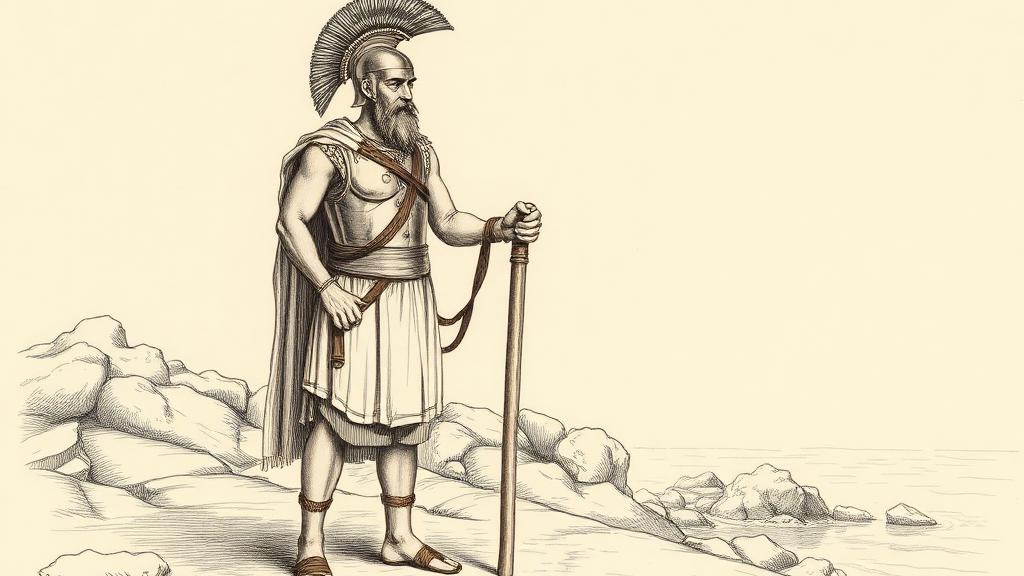
The scytale, or how Sparta encrypted its orders
In 404 BCE, at the Hellespont, the Spartan admiral Lysander received a strip of leather from a messenger. He wound it around a wooden staff he carried at his hip, and the scattered letters resolved into a sentence: come home, or face execution. He had been plundering Persian territories without authorization, and the ephors — Sparta’s ruling council of five — had run out of patience. Plutarch records that Lysander “was much disturbed” by the message. The device that delivered it was a scytale, and it was already ancient.
The scytale — the word means “staff” or “baton” in Greek — was the Spartan answer to a problem as old as warfare: how do you send orders across hostile territory without your enemies reading them? The device was deliberately simple. The ephors in Sparta and their generals in the field each held an identical wooden cylinder. When a message needed sending, a narrow strip of leather parchment was wound in a tight spiral around the staff, and the text was written across the overlapping edges. Unwound, the strip became nonsense — a scatter of unrelated letters that gave nothing away. Only a cylinder of precisely the same diameter could restore the spiral, and therefore the message.
This makes the scytale the earliest known transposition cipher — a method that scrambles the positions of letters rather than replacing them. The distinction matters. A substitution cipher swaps A for D, B for E; crack the mapping, crack the message. A transposition cipher shuffles the letters themselves, so the solution is not a code-table but a physical key. In this case, a stick.
The clearest descriptions we have come from Plutarch, writing in the first century AD, some four centuries after the events he describes. He names Lysander, Clearchus, and Agesilaus as generals who sent or received scytale dispatches. Thucydides, writing much closer to the period, makes oblique references to Spartan secret communications without describing the device directly. The historical record is honest about what it doesn’t know.
Modern scholars have raised a pointed question: was the scytale actually a cipher at all? Thomas Kelly and others have argued that the cryptographic value was low — an enemy who captured a strip and a staff of roughly similar diameter could simply try different widths until the message appeared. The more plausible function, scholars suggest, was authentication: a strip that could only be read on a matching staff proved the message came from a sender who held that staff. Not secrecy, but identity. Sparta’s military communications cared less about concealing content than confirming legitimacy. The scytale may have been, essentially, the world’s first tamper-evident envelope.
Either way, the scytale introduced a concept that would run through every cryptographic system that followed: the shared secret. Both parties hold something — a key, a codebook, a pair of identical staffs — that outsiders do not. The security of the message depends entirely on the security of that shared object. Two thousand years later, mathematicians would spend careers on the fundamental problem this creates: how do you share the secret without sharing it in the open?
That problem is still live. The answer, when it finally came, did not require a wooden staff.
Sources
- Scytale — Wikipedia — History, earliest mentions, how the device worked, primary sources from Plutarch and Apollonius of Rhodes, and the debate over its cryptographic function.
- Deciphering the Spartan Scytale — Antigone Journal — The Lysander incident at the Hellespont, details from Plutarch’s Lives, Thucydides’ oblique references, and the scholarly case for authentication over encryption.