Greek krepis and kothornos — the shoe as theater
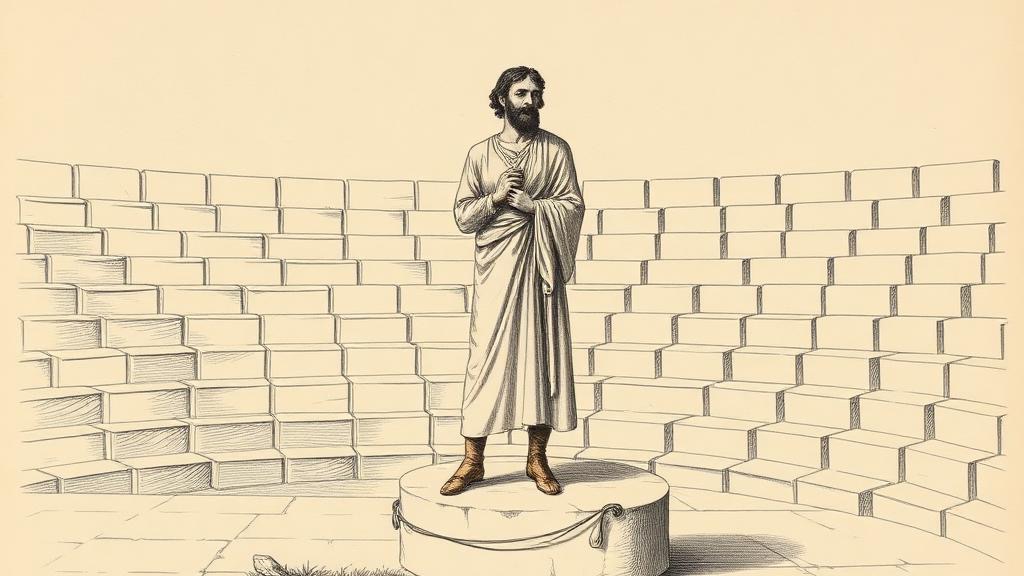
The Theater of Dionysus at Athens, 458 BCE. The chorus files in wearing masks and robes, but look at the feet: strapped into thick-soled boots with cork-packed platforms that add three, perhaps four inches of height. When an actor playing Agamemnon strides across the orchestra, he does not merely walk — he looms. This is the kothornos, and Aeschylus put it there on purpose.
The kothornos started as a hunting boot, soft leather laced to the knee, designed to keep thorns and wet grass off a man’s shins. Sometime in the first half of the fifth century BCE, the playwright Aeschylus commandeered it for the stage. He stacked the soles with cork, added height, and put it on his tragic actors — making mortal men appear to be something closer to the gods they were portraying. The result was so compelling that the word itself became a metonym for tragedy, the way “the boards” now stands for the stage (Wikipedia).
The kothornos carried one further distinction: it was reversible. Unlike nearly any other shoe of its age, it could be worn on either foot. An actor playing a king in act one and a herald in act three needed only one pair — just flip them. The Greeks had apparently decided that if you were already disguising yourself as a demigod, worrying about left and right was beside the point.
Alongside the kothornos sat the everyday workhorse of the Greek world: the krepis. Rugged-soled, sometimes nail-studded, with straps that wound up the shin, it occupied the middle ground between sandal and closed boot (Wikipedia). Soldiers wore it on campaign, travelers wore it on mountain paths, and it was considered so characteristic of Greek culture that Roman tragedies performed in Greek costume were classified as “fabula crepidata” — plays of the krepis. Sophocles reportedly gave his tragic performers white krepides, picking them out against the stone orchestra even from the back rows.
The Theater of Dionysus made the contrast explicit. Tragic actors wore the tall kothornos; comic actors wore the soccus, a flat slip-on barely thicker than a sole. Sock and buskin. The Romans carried the distinction into Latin literature, and Shakespeare’s contemporaries still used “buskin” for tragedy and “sock” for comedy two thousand years after Aeschylus first stacked the cork. The shoes were a language, and the audience read them from the cheap seats.
What Athens worked out, between the krepis and the kothornos, is that footwear is never neutral. It is the first signal a person gives — before they speak, before they gesture — about who they are supposed to be. A shoemaker in the Athenian agora was not only selling protection against rough roads. He was supplying the grammar of self-presentation to an entire civilization.
The grammar hasn’t changed. We’ve simply built larger stages.
Sources
- Buskin — Wikipedia — kothornos as hunting boot, Aeschylus’s adoption for tragic theater, contrast with the comedic soccus.
- Crepida — Wikipedia — design and construction of the krepis, “national shoe of the Greeks,” fabula crepidata, Sophocles’s white performers’ versions.
- Symbolic Steps: Footwear of Ancient Greece — eCampus Ontario — types of footwear, materials, social distinctions, archaeological finds from the Kerameikos.