The Prior Analytics, or the first argument written in letters
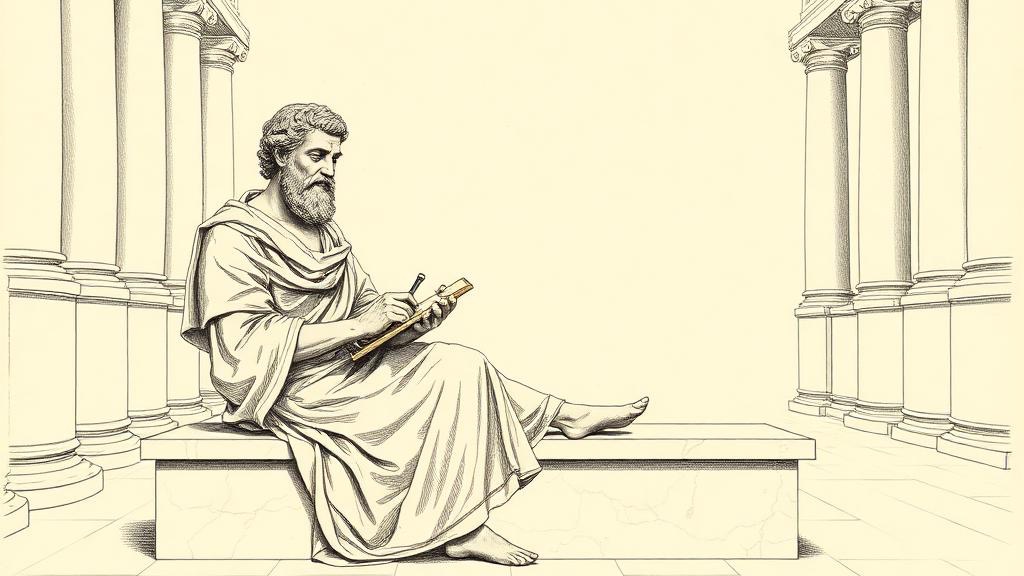
Sometime around 350 BCE, in a public gymnasium on the eastern outskirts of Athens called the Lyceum, Aristotle replaced Socrates with a letter. Not as an insult — as a method. Where a less systematic philosopher might argue “All men are mortal; Socrates is a man; therefore Socrates is mortal,” Aristotle wrote instead: if every B is an A, and every C is a B, then every C is an A. Socrates had been abstracted away. What remained was pure shape — a rule that worked not because of anything specific about Socrates, but because of the structure of the argument itself.
The work is the Prior Analytics, part of six treatises that later editors collected under the title Organon — Greek for “tool” — composed around 350 BCE (Stanford Encyclopedia of Philosophy). They called it a tool deliberately: Aristotle himself considered logic not a branch of philosophy but an instrument available to all branches. He defined a syllogism as “a discourse in which, certain things being supposed, something different from the things supposed results of necessity because these things are so” (Wikipedia). He then catalogued 256 possible argument forms built from three terms, reducing them by systematic proof to a handful of “perfect” first-figure deductions — shapes so self-evidently valid that no further justification was needed.
The innovation that mattered most was buried in the notation: letters. Aristotle used A, B, and C where previous philosophers had used Socrates, Men, and Mortality — and in doing so became the first logician in recorded history to employ variables (Britannica). Without variables, you can validate a specific argument. With them, you can state a rule that governs every argument of the same shape, regardless of what the shapes contain. The leap from “Socrates is mortal” to “every C is an A” is the same leap, conceptually, as the one from counting sheep to inventing algebra.
Medieval scholars liked the syllogism system well enough to give every valid form a Latin name in which the vowels encoded the argument’s structure: A for a universal affirmative premise, E for a universal negative, I for a particular affirmative, O for a particular negative (Wikipedia). The most fundamental form — three universal affirmatives — became Barbara. The second, Celarent. There are nineteen valid forms in all, each with its mnemonic, and scholars were still reciting them in universities into the 17th century, treating them the way a musician treats scales.
Aristotle’s logic dominated Western intellectual life for roughly two thousand years. Leibniz, in the 1670s, still measured his ambitions against it: he wanted a calculus ratiocinator, a symbolic calculus capable of making all disputes decidable by calculation. George Boole, in 1854, finally turned the letters algebraic. By 1943, McCulloch and Pitts were drawing neurons that fired on logical rules. By 1956, Newell and Simon’s Logic Theorist was running proofs on a machine.
The syllogism that concluded Socrates was mortal is still running, in every inference engine and language model that has ever been built — the names swapped out, the structure held constant. Aristotle’s real contribution was not the rules themselves but the discovery that the rules could be written down at all.
Sources
- Aristotle’s Logic — Stanford Encyclopedia of Philosophy — variables, axiomatic structure, metatheoretical results, definition of syllogism, two-thousand-year dominance.
- Prior Analytics — Wikipedia — syllogism definition, cataloguing of 256 argument forms, medieval mnemonic names (Barbara, Celarent).
- History of Logic: Aristotle — Britannica — first use of variables in logic, formal treatment of argument forms, founding of logic as a discipline.