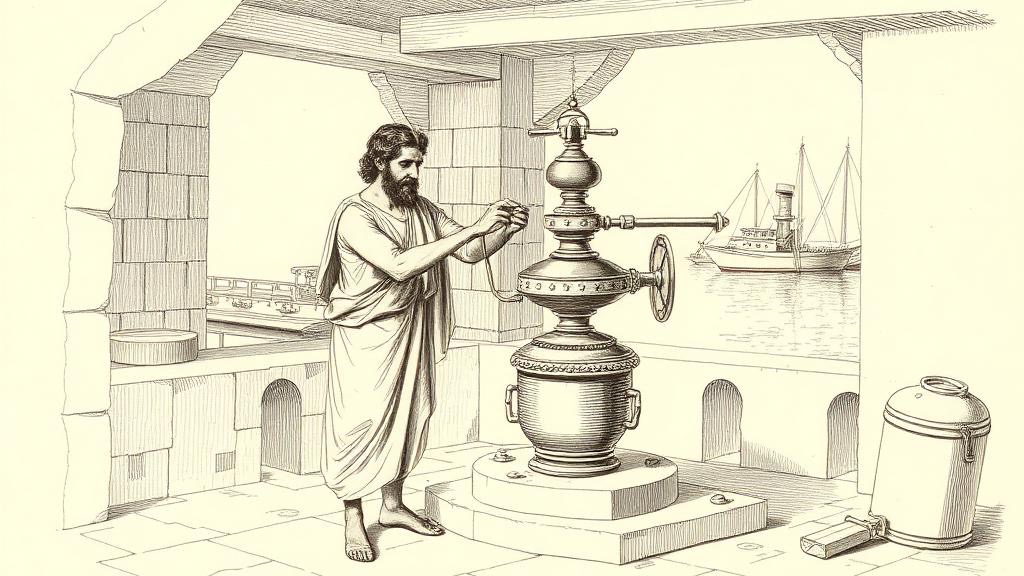
Ctesibius's clepsydra, or the water clock that fixed itself
In a workshop near the harbor at Alexandria, around 270 BCE, a man named Ctesibius was fitting a float valve into a bronze vessel. He was the son of a barber — and, for a time, a barber himself — which may explain why he understood that even a small imprecision, accumulated hour after hour, becomes intolerable.
The water clock had existed for a thousand years before he touched it. Egyptian clepsydras were stone vessels with a hole near the base: water drained out, the level fell, and marks on the interior told you which hour you were in. They worked, after a fashion. But as the vessel emptied, the water pressure dropped and the flow slowed, so the later hours of the day stretched longer than the earlier ones — not by much in any single hour, but enough to make the clock unreliable across a full day. It was a clock with a built-in lie.
Ctesibius’s fix was three-tiered (Wikipedia). A large supply tank fed water into a smaller intermediate chamber through a float valve: as the level in the chamber rose, the float rose with it and eventually closed the inlet, holding the surface at a constant height. From this constant-head chamber, water dripped at an unvarying rate into a third vessel below, where a float carried a vertical pointer up along a column of hour marks. The drip rate never changed. The pointer climbed at a steady pace. The clock now told the truth.
What Ctesibius had built, without naming it as such, was the first known feedback control system — a mechanism that sensed its own state and corrected for drift (Britannica). Engineers would not give that pattern a formal name for roughly twenty-two centuries. His own writings are entirely lost; we know the device only through Vitruvius’s De architectura and Hero of Alexandria’s later treatises, both of which describe it with admiration. The logic, however, speaks for itself: measure the level, hold it constant, let the output follow.
The Alexandrian physician Herophilos put the improved design to immediate use. On his house calls he carried a portable version of the clepsydra, counting patients’ pulse beats against a reference table he had compiled by age (Wikipedia). Too fast for a man of forty meant fever or distress; below normal in an elder, something else. It was, as far as the record shows, the first time a clock was used as medical equipment.
Ctesibius’s design held the accuracy record for roughly eighteen hundred years, until Christiaan Huygens built the first pendulum clock in 1656. The barber’s son from Alexandria had, through a float valve and a steady drip, bought the ancient world nearly two millennia of the best time it had.
Every toilet tank, every carburetor, every hydraulic feedback loop built since operates on the same principle: hold the input constant, and the output takes care of itself. The vessel changed. The idea has not moved.
Sources
- Water clock — Wikipedia — constant-head mechanism, three-tier design, Herophilos’s use of portable clepsydra for pulse measurement.
- Ctesibius of Alexandria — Britannica — barber origins, the improved clepsydra, Ctesibius as the first great Alexandrian engineer.