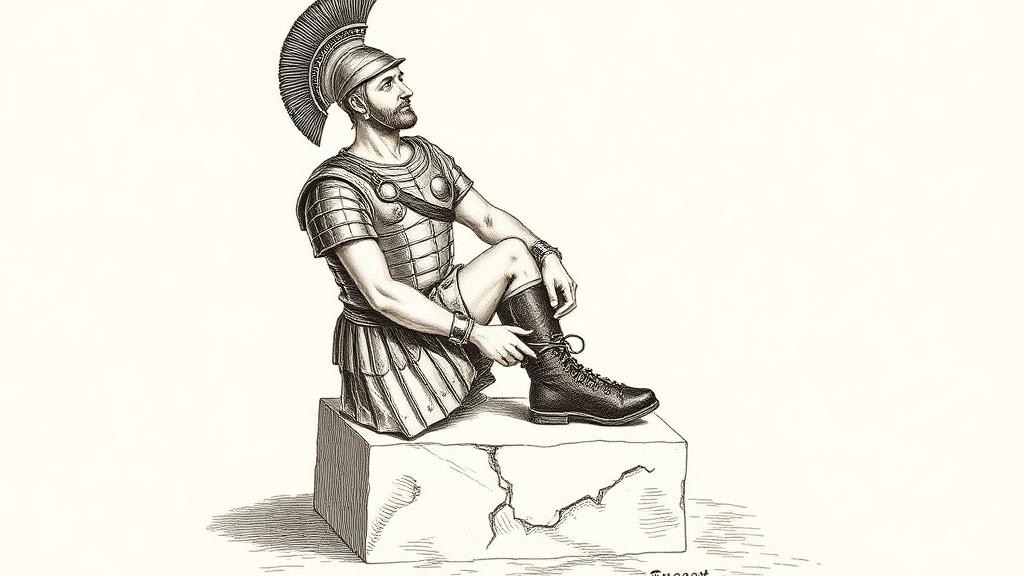
Roman caligae, or why the empire marched on hobnails
In AD 70, as Roman troops stormed the Temple of Jerusalem, a centurion named Julianus charged forward through the melee and then, abruptly, fell. Not to a sword. Not to an arrow. The marble floor of the Temple Mount had defeated him. His caligae — the iron-studded boots that had carried him across the empire — turned him into a projectile on polished stone, and the men he’d been attacking had a moment to recover. Josephus, who was present and recorded the assault, noted the incident with the detachment of a man who had seen rather a lot that day.
The caliga was the standard boot of the Roman legionary from at least the late Republic through the 2nd century AD — perhaps two hundred years as the single most-worn piece of military footwear in the ancient world. Its design was elegant in the way that only useful things are. Uppers and midsole were cut from a single piece of ox-hide, pierced and pulled into an openwork lattice that laced across the top of the foot and around the ankle. The outer sole was then nailed to the midsole, typically with 40 to 150 iron hobnails per boot. A soldier could march 25 miles without blisters — the open design kept air moving around the foot all day.
Those hobnails deserve attention. They were not army issue; each soldier purchased his own studs and had them fitted. They provided traction on packed earth, gripped scree, and could, in a press of battle, be used to stamp on a fallen opponent as the line advanced. They also, as Julianus discovered, did absolutely nothing on smooth marble.
The boots were common enough that they named an emperor. Around AD 14, the future Caligula was a toddler living in his father Germanicus’s military camp on the Rhine. The soldiers dressed the small boy in a miniature uniform, complete with scaled-down caligae, and called him “Caligula” — little boot. He eventually ruled Rome for four years, which was not uniformly pleasant for anyone involved, but the nickname preceded the man and outlasted him by two thousand years.
By the late 2nd century the caliga was fading from military service. As the legions pushed further into Britain and the Germanic forests, the open design that worked beautifully on Italian summer roads became a liability in cold, wet northern winters. Closed boots replaced them — first in the north, then through the empire. Diocletian’s Edict on Maximum Prices, issued in AD 301, still lists caligae, but now as civilian footwear, which tells you everything you need to know about where the design had ended up.
Vindolanda, the Roman fort on Hadrian’s Wall in Northumberland, preserves this transition in leather. The fort’s damp anaerobic soil has yielded more than 7,000 Roman shoes — the largest collection from anywhere in the empire — including a hoard of 421 pairs uncovered in 2016, discarded into a defensive ditch around AD 212. Among them: caligae, bath clogs, women’s slippers, children’s boots, one child’s shoe that archaeologists noted looked remarkably like an Adidas Predator. The whole ditch is a snapshot of a garrison deciding, after two centuries of hobnails, that it was finally too cold to march in open sandals.
The legions that conquered Britain, Gaul, Spain, North Africa, and the Near East did so largely on foot. That foot wore a caliga. The tens of thousands of kilometers of Roman road — paved and surveyed — were built, in part, to be walked in exactly this kind of boot. The road and the shoe designed themselves around each other, as tools always do.
Sources
- Caligae — Wikipedia — construction details, hobnail patterns, the Caligula nickname, the Julianus incident, and the timeline of decline.
- Roman Soldier’s Footwear — Romans in Britain — hobnail purchase practices, transition to calcei, and the Vindolanda evidence.
- The Roman Shoe Hoard of Vindolanda — HeritageDaily — the 2016 hoard of 421 shoes, types found, anaerobic preservation, and the AD 212 abandonment date.