The slide rule, or how a clergyman's shortcut ran the world for three centuries
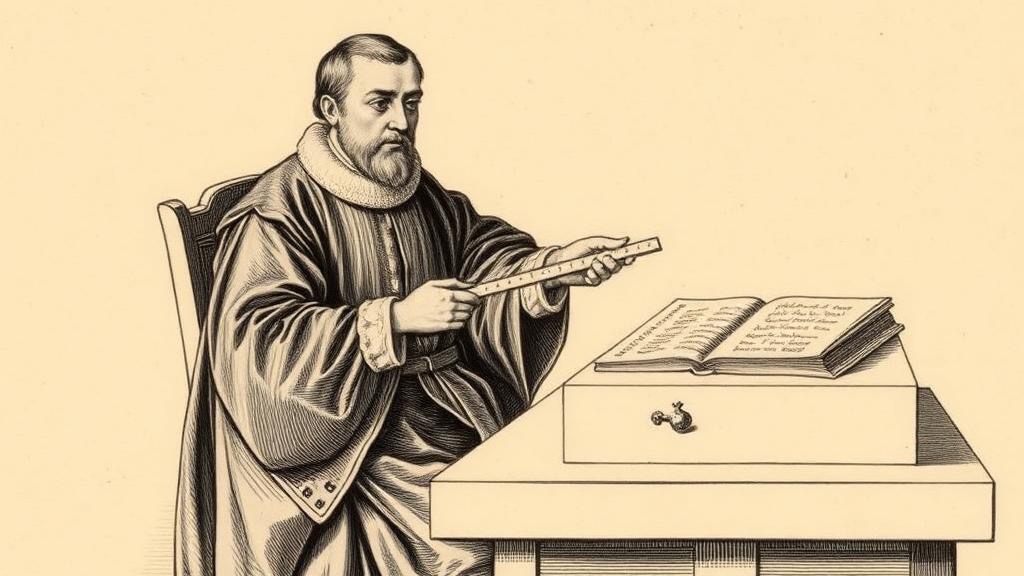
In the study of a rectory in Albury, Surrey, sometime around 1622, an Anglican priest named William Oughtred picked up two identical logarithmic rulers and pressed them together. Both bore a scale Edmund Gunter had devised two years earlier in London — numbers spaced not evenly, but in proportion to their logarithms. Oughtred slid one ruler against the other. When the scales aligned, the result read off directly, no arithmetic required. He had, more or less by accident, invented the most important calculating tool the world would not let go of for the next three hundred and fifty years.
The backstory runs through John Napier, the Scottish laird whose logarithms had upended arithmetic in 1614. Napier had shown that multiplication could be recast as addition if you first converted numbers into their logarithms, added the logs, and converted back — laboriously, via tables. Edmund Gunter (1581–1626), Gresham Professor of Astronomy in London, saw that you could make the conversion physical: etch a logarithmic scale onto a two-foot rule, and a pair of dividers could add lengths instead of crunching numbers by hand (Wikipedia). By 1620 he had his “Gunter’s line,” and navigators were using it aboard ships.
What Oughtred added was the move from one scale to two. Press a second Gunter rule against the first and slide it until one end aligns with your first number. Your second number on the moving scale then points to the answer on the fixed one — no dividers, no pencil, no calculation. The scales themselves perform the addition of logarithms, which is the multiplication of the original numbers (Whipple Museum). Oughtred also designed a circular version using concentric rings — same principle, more compact. A single instrument could multiply, divide, extract roots, and handle trigonometric functions.
Oughtred, for his part, was not entirely comfortable with what he had made. He wrote that “the true way of Art is not by Instruments, but by Demonstration” and complained that practitioners who relied on mechanical shortcuts made students “mere doers of tricks, as it were Juglers” (Whipple Museum). The man who handed engineers their defining tool for three centuries believed, sincerely, that using it was a form of intellectual surrender. He also never published the invention himself. In 1630, his former student Richard Delamain — tutor to King Charles I — produced a pamphlet claiming he had invented the slide rule. Oughtred responded at length and with evident fury. The dispute ran for years and was eventually resolved in Oughtred’s favor by witnesses who had seen the device in his study before Delamain went to print (Wikipedia).
For the next three and a half centuries, the slide rule was the engineer’s constant companion — in design offices, aboard ships, in the laboratories where the industrial world was being built. Nevil Shute Norway, designing the British R100 airship in the 1920s, described working with one as producing “a satisfaction almost amounting to a religious experience” (Wikipedia). No electrical connection required, no battery to fail. Just two scales, and a trained hand.
When the Texas Instruments SR-50 arrived in 1974, engineers put their slide rules in drawers and did not open them again. The calculation hadn’t changed — only the thing doing it.
Sources
- Slide rule — Wikipedia — Gunter’s line (1620), Oughtred’s invention (~1622), the Delamain priority dispute, the Nevil Shute Norway anecdote.
- Slide rules — Whipple Museum of the History of Science — Oughtred’s philosophy on instruments, the mechanism of two Gunter scales, evolution of designs.