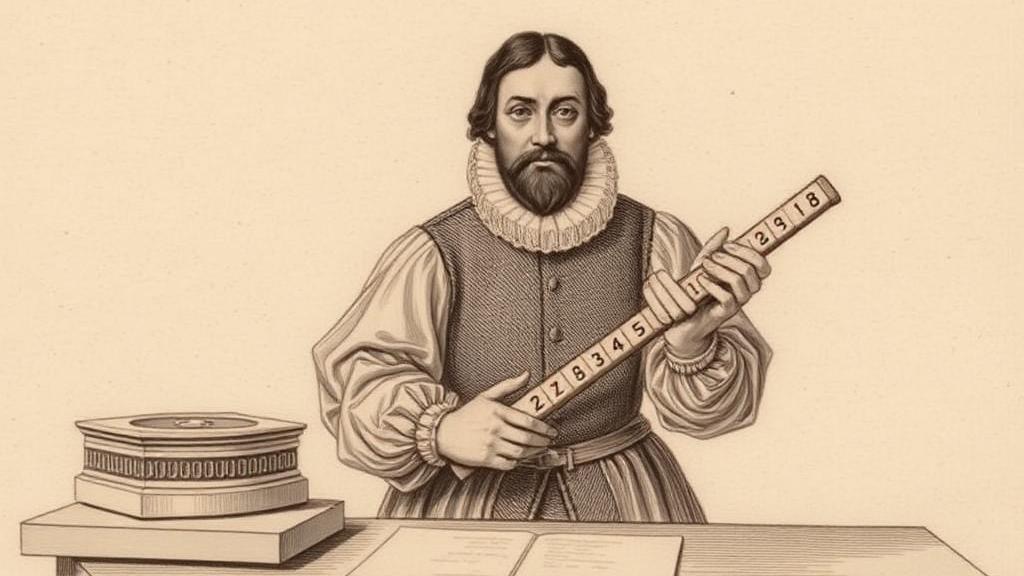
Napier's bones, or how a Scottish laird made multiplication optional
The year is 1617 and John Napier of Merchiston, a Scottish laird with a reputation for keeping a jet-black cockerel to detect thieves among his servants, is dying in his castle on the edge of Edinburgh (Royal Society). He will not see his sixty-eighth year. But in that same year, in a slim Latin treatise called Rabdologiae, he publishes a set of numbered rods so useful that merchants and navigators across Europe will still be reaching for them a century later. The rods outlast the legend of the cockerel by some distance.
Napier was born in 1550 into a family of Scottish Protestant nobility with more land than mathematical instruction. He studied at St Andrews, possibly for a matter of months, then appears to have taught himself the rest — his collected works suggest someone who read theology, military theory, and arithmetic with equal appetite (Britannica). His most celebrated contribution was the invention of logarithms, published three years before the bones, in 1614: Mirifici logarithmorum canonis descriptio, a table that converted multiplication into addition by mapping products across a fixed scale. He had been working on it since approximately 1594. Twenty years of calculation, distilled to a set of pages.
The bones in Rabdologiae are simpler in concept and more immediately graspable: a set of rods, typically made of ivory or bone (hence the name), each face inscribed with a single digit’s multiplication table arranged in a grid of nine squares (Wikipedia). Each square is divided diagonally — units in the lower-right triangle, tens in the upper-left. Lay several rods side by side to represent any multi-digit number, read across the row for your multiplier, then add the diagonal pairs from right to left. What was a multiplication problem becomes an addition problem. A merchant who could add but found long multiplication treacherous now had a mechanical shortcut that fit in a coat pocket.
There is a small irony buried in the Rabdologiae. Napier plainly regarded logarithms as his signature achievement — the bones were one of three auxiliary devices he described almost as an afterthought, practical tools for readers who might find the logarithm tables fiddly in the field. But the bones, tactile and teachable, spread faster than the tables among the engineers and merchants who needed rapid arithmetic most. The abstraction that took twenty years was slower to travel than the rods he described in the same year he died.
What the bones set in motion is more consequential than the bones themselves. Within six years of Rabdologiae, the German astronomer Wilhelm Schickard had drawn plans for a mechanical calculating machine that incorporated Napier’s rods in rotating cylinders — the earliest known design for a device that could carry and borrow automatically (Wikipedia). The bones handed the next generation a working premise: that arithmetic could be mechanized, one digit at a time. Pascal’s Pascaline, Leibniz’s Stepped Reckoner, the whole lineage of gear-and-wheel calculators drew on that premise, whether or not their inventors acknowledged the debt.
Every multiplication Napier replaced with addition was a small proof: complex operations can be decomposed into simpler ones and handed to something else. The machines were coming whether or not he knew it.
Sources
- Napier’s bones — Wikipedia — mechanical operation of the rods, history, evolution into Genaille-Lucas rulers.
- John Napier — Encyclopaedia Britannica — biography, logarithms, dates, Rabdologiae.
- Counting Bones: Napier’s Mathematical Legacy — Royal Society — the black cockerel legend, Henry Briggs connection, Napier’s broader influence.