Llull's Ars Magna, or how a troubadour built the first reasoning machine
In the winter of 1263, a Majorcan troubadour named Ramon sat at his table composing a love song when, according to his own account, Christ appeared on the Cross above him. This happened five times. By the fifth vision he had traded the lyric for an ambition large enough to consume the remaining fifty years of his life: write the greatest book ever made against the errors of the unbelievers. He would not argue by scripture. He would argue by machine.
Ramon Llull was born around 1232 in Palma de Mallorca, the son of a merchant family that had arrived with the Christian reconquest of the island. He spent his youth at court — writing verse, probably drinking, certainly not worrying about the salvation of the Saracens. Then the visions arrived and everything changed. He learned Arabic from a slave he bought for the purpose, studied Islamic and Jewish philosophy, and spent nine years working out a system he called the Ars — the Art.
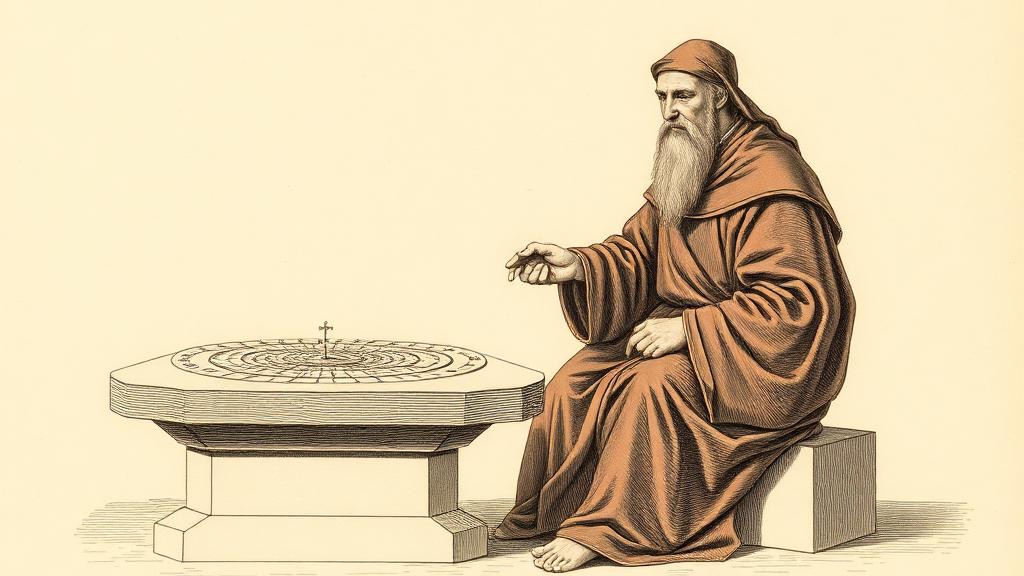
The Ars Generalis Ultima of 1305, the final and most refined version, is the thing that keeps computer scientists up at night. Its central mechanism was three concentric paper discs, each inscribed with nine letters (B through K) standing for the nine divine perfections: goodness, greatness, eternity, power, wisdom, will, virtue, truth, glory. (Stanford Encyclopedia of Philosophy) You rotated the outer wheel against the inner wheels, pairing and tripling letters according to prescribed rules, and the device generated combinations: “goodness is great,” “what is the power of eternity?” — logically valid propositions produced without thinking, by the geometry of the thing itself. Llull claimed that if you exhausted all combinations and applied the rules faithfully, no heretic could refuse the conclusions. God’s existence was a mathematical inevitability.
The inspiration for the mechanism almost certainly came from the Islamic world. Arab astrologers of the day used a device called a zairja — concentric rings encoding the ninety-nine Names of God — to generate meaningful combinations of divine attributes. Llull, whose first serious study was Al-Ghazali’s logic, understood the combinatorial principle and turned it onto Christian apologetics with the confidence of a man who had received five visions and was not about to second-guess them.
He tested the machine in the field. In 1293, Llull sailed for Tunis to convert the Hafsid sultan by sheer force of logic — then turned back from the dock in terror, standing on the wharf in Genoa as his ship pulled away without him. He fell ill with shame, eventually recovered, and got on the next boat. He was arrested on arrival, imprisoned for six months, and expelled. He made at least two more missions after that. The Ars did not convert as many Saracens as Llull had hoped. It converted rather more mathematicians.
Gottfried Leibniz, writing in 1666, explicitly named Llull when he laid out his own De Arte Combinatoria — the project of reducing all human reasoning to symbol manipulation, which is more or less the founding charter of symbolic AI. The wheels had become a metaphor, then a method. The insight that remained — stripped of the divine dignities and the missionary urgency — was this: reasoning might be a procedure. Fix your primitives, specify your rules, turn the crank. The conclusions follow.
Llull died around 1316, probably in Tunis or on the crossing home, aged about eighty-four. He never saw the mathematics come loose from the theology. But the wheels kept spinning without him — and they are spinning still, now as matrices of weights turning through billions of combinations in search of the right answer.
Sources
- Ramon Llull — Stanford Encyclopedia of Philosophy — life dates, the nine dignities, the ternary phase and rotating figures, the Art’s combinatorial mechanics, and its significance for the history of logic.
- Ramon Llull — Wikipedia — biographical overview, the zairja influence, the Leibniz connection, and the missionary voyages to Tunis.