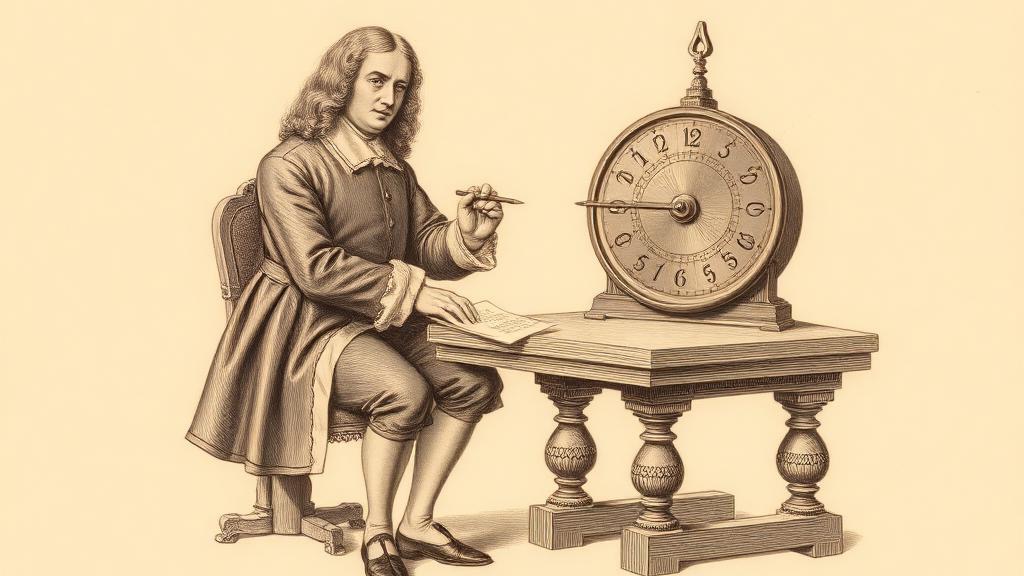
Pascal's Pascaline, or how a teenager tried to spare his father from arithmetic
A brass box the size of a shoebox, its face fitted with a row of small windows and a ring of numbered dials. You press a stylus between the spokes and turn. As you pass from nine to zero, something clicks — a tiny gravity-driven mechanism catches, and the next column advances by one without you having to touch it. Rouen, France, 1645: Blaise Pascal, twenty-one years old, has just demonstrated that a machine can carry.
The backstory is domestic and practical. In 1639, Pascal’s father Étienne — a royal tax commissioner — moved the family to Rouen to oversee the accounts for Normandy, a province with no shortage of taxpayers or arithmetic. The elder Pascal spent his days grinding through columns of figures, adding and re-adding to check his work. His son watched, and was either moved by filial sympathy or offended by inefficiency; the historical record does not specify which. Over the next three years, Blaise built roughly fifty prototypes — a number that tells you something about both the difficulty of the problem and his stubbornness in solving it (Wikipedia).
The Pascaline was a gear-and-dial machine that could add and subtract directly, and multiply or divide through repeated operations. What made it genuinely new was a mechanism Pascal called the sautoir — French for “jumper” — an internal carry device driven by a falling weight. When a wheel rolled past nine and back to zero, gravity tripped the sautoir and incremented the next column automatically. No earlier calculating aid had done that mechanically; the abacus and Napier’s Bones both required the human hand at every step. The Pascaline moved the carry on its own (Britannica).
King Louis XIV was impressed enough to grant Pascal a royal privilege in 1649 — effectively a monopoly on mechanical calculators in France. With official protection and a legitimate market, the machine should have sold. It didn’t. Production stopped around 1654 with fewer than twenty units built. The machines were expensive, fragile, and demanded a level of precision manufacturing that seventeenth-century craftsmen could barely maintain. Nine Pascalines survive today, distributed across museums in Paris, London, and Dresden — artifacts that arrived too early for the infrastructure they needed.
The commercial failure matters less than the conceptual breakthrough. Pascal had proved that mechanical gears could do something the human brain had always reserved for itself: manage carries across columns without supervision. That one small automation — a weight falling, a wheel clicking forward — was the germ of everything that followed. Leibniz would come next, with a machine that could multiply and divide, and the logic would keep compounding from there.
The sautoir had a simple job: catch the carry and pass it on. It is still what every computer on earth does, four hundred billion times a second.
Sources
- Pascaline — Wikipedia — mechanical design, production history, surviving units, royal privilege.
- Pascaline — Encyclopaedia Britannica — the sautoir carry mechanism, Pascal’s motivation, comparison with earlier calculating aids.