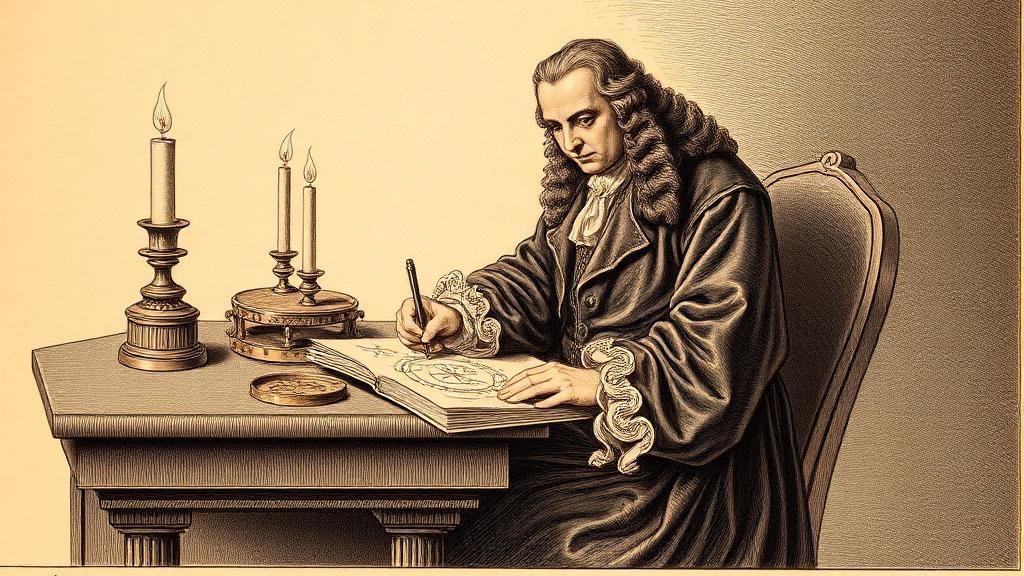
Leibniz's calculus ratiocinator, or let us calculate who is right
In the summer of 1879, workmen clearing an attic in Göttingen found a brass-and-wood contraption no one could identify. When they worked out what it was — a calculating machine built two centuries earlier and left there forgotten — the irony was almost too tidy: the inventor had spent his life arguing that reasoning itself could be mechanized, and here was his physical model, sitting in a box, waiting.
The inventor was Gottfried Wilhelm Leibniz, born in Leipzig in 1646, a polymath in the way the 17th century still occasionally permitted — mathematician, philosopher, diplomat, and court librarian to the House of Brunswick in Hanover. He co-invented calculus simultaneously and independently with Newton, a coincidence the two men spent decades making each other miserable about. He built the stepped reckoner, a brass cylinder device capable of multiplication and division as well as addition. And sometime around 1679, extending an idea he had first sketched at nineteen in De Arte Combinatoria, he began the more radical project: not a machine that computed numbers, but a machine that computed thoughts.
The plan had two parts. The first was the characteristica universalis — a universal symbolic language in which every human concept would be assigned a character, the way every quantity gets a numeral. The second was the calculus ratiocinator — an inference engine that would operate on those characters as arithmetic operates on digits, grinding new truths out of old ones by mechanical rule. Together they would do for argument what the printing press had done for text: make it portable, auditable, and independent of whoever happened to be holding the pen.
He stated the ambition plainly in The Art of Discovery in 1685: “The only way to rectify our reasonings is to make them as tangible as those of the Mathematicians, so that we can find our error at a glance, and when there are disputes among persons, we can simply say: Let us calculate, without further ado, to see who is right.” Calculemus. It is either the most optimistic sentence in the history of ideas, or the most naive — the answer depends on which century you’re reading it from.
Jonathan Swift, for one, was not persuaded. In Gulliver’s Travels (1726), he placed a scene in the Academy of Lagado where scholars cranked a wooden frame fitted with wires and pegs that shuffled words at random, printed the results, and called it philosophy. The satire was not subtle. But Swift’s ridicule also confirmed that the project was famous enough to mock; Leibniz had at least planted the question in the air.
The real irony is that he never closed it. The characteristica stayed a vision; the calculus was sketched but never operational. Most of his logical writings remained unpublished in the Hanover archive until an 1839 edition finally exposed them. When George Boole encountered the work decades after publishing his own Laws of Thought (1854), his widow recorded that he felt “as if Leibniz had come and shaken hands with him across the centuries.” Leibniz had arrived first and told no one who was listening.
The inheritance runs forward without a break. Norbert Wiener, writing in 1948, traced the modern computing machine directly back to Leibniz. Herbert Simon and Allen Newell, building the Logic Theorist in 1956 — the first program to prove mathematical theorems from scratch — named him a forerunner. The calculemus had to wait three hundred years for hardware fast enough to try it.
Three centuries on, machines prove theorems, translate languages, and generate images from text — which is either what Leibniz meant by calculemus, or a more interesting question than he thought to ask.
Sources
- Characteristica universalis — Wikipedia — overview of Leibniz’s universal language project, from 1666 onward.
- Calculus ratiocinator — Wikipedia — Wiener’s attribution, Newell and Simon’s acknowledgment, the two-tradition debate.
- “Let us Calculate!”: Leibniz, Llull, and the Computational Imagination — Public Domain Review — the Göttingen attic discovery, the stepped reckoner, Swift’s satire in Gulliver’s Travels.
- Leibniz’s Influence on 19th Century Logic — Stanford Encyclopedia of Philosophy — Boole’s response, the unpublished Hanover archive, the 1839 Erdmann edition.