computing · 3 min read
Leibniz's Stepped Reckoner, or what a pedometer started
A pedometer, of all things, was the spark. In a note written in 1685, Gottfried Wilhelm Leibniz described what had set him on the path: he had been shown “an instrument which, when carried, automatically records the numbers of steps taken by a pedestrian.” The clicking wheel registered each step without anyone thinking about it — the count just accumulated. He wrote that this made him conceive “that the entire arithmetic could be subjected to a similar kind of machinery.” Twenty years of work followed from that sentence.
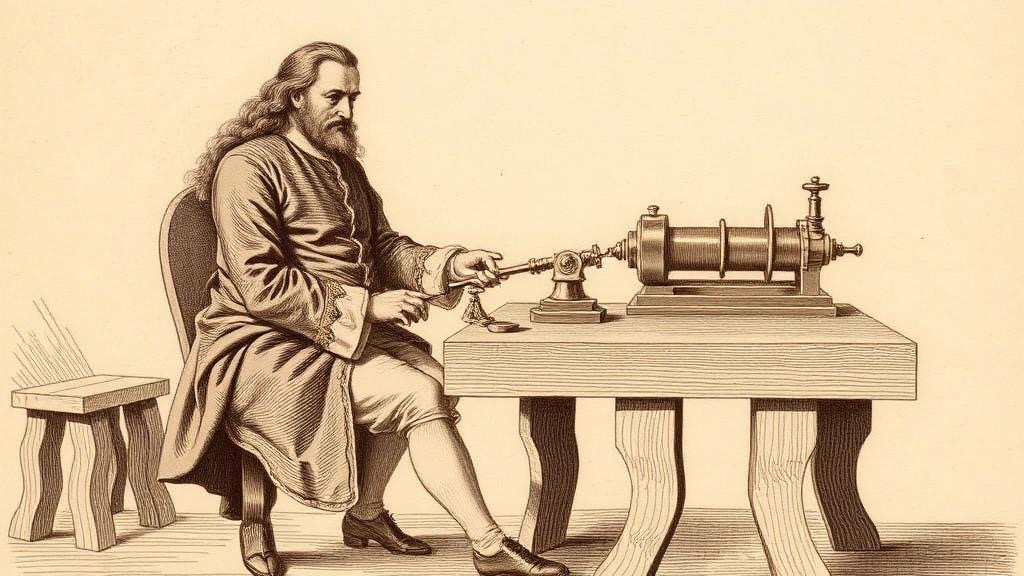
By 1673, Leibniz had a wooden demonstration model ready, which he carried to the Royal Society of London. The Fellows were attentive; the wood was not yet convincing. He went home and kept building. The finished machine arrived in 1694: a brass-and-steel instrument roughly 67 centimetres long, housed in an oak case, with an 8-digit input section up front and a 16-digit accumulator at the back, turned by a hand crank (Wikipedia).
The key invention was what Leibniz called the Staffelwalze — the stepped drum. It was a brass cylinder with nine rows of teeth, each row one tooth longer than the last, so that rotating the drum by a fixed amount engaged a varying number of teeth on the counting wheel. Set the input to 7, turn the crank, and seven teeth engage: the accumulator advances by seven. Repeat nine times and you have multiplied. The same logic, run in reverse, divides. No calculating instrument had managed all four arithmetic operations in a single device before this one (Britannica).
Leibniz had a talent for memorable justification. “It is beneath the dignity of excellent men,” he wrote, “to waste their time in calculation when any peasant could do the work just as accurately with the aid of a machine.” He was not merely flattering potential patrons; he genuinely believed that systematic thought could be mechanised, and that machines should absorb the drudgery so that human minds could reach for harder problems. The argument lands the same way in every era it has been made.
The irony is that the Stepped Reckoner mostly didn’t work. A flaw in the carry mechanism caused it to misbehave on certain inputs, and the precision required to build a reliable version exceeded what seventeenth-century craftsmen could consistently deliver. Only two prototypes were made. One of them was sent to the University of Göttingen for repair in 1775 and promptly forgotten. In 1876 — a hundred and one years later — a crew of workmen found it in an attic. It was returned to Hanover in 1880, restored between 1894 and 1896, and today sits in the National Library of Lower Saxony: a machine that spent a century gathering dust and still outlasted most of its contemporary technology by several hundred years (Wikipedia).
The Leibniz wheel did not fade with its inventor. The stepped-drum principle reappeared in calculators built across the eighteenth and nineteenth centuries, was refined rather than replaced, and is still visible in the Curta — a hand-cranked calculator manufactured in Liechtenstein until 1972. A gear profile conceived in the 1690s was spinning in people’s briefcases when the first pocket calculator appeared.
The pedometer idea never stopped walking.
Sources
- Stepped reckoner — Wikipedia — timeline (1673 demo, 1694 completion), machine dimensions, the Staffelwalze mechanism, attic rediscovery, Leibniz wheel legacy through to the Curta.
- Step Reckoner — Encyclopaedia Britannica — mechanical design, all-four-operations significance, relation to Pascal’s earlier work.