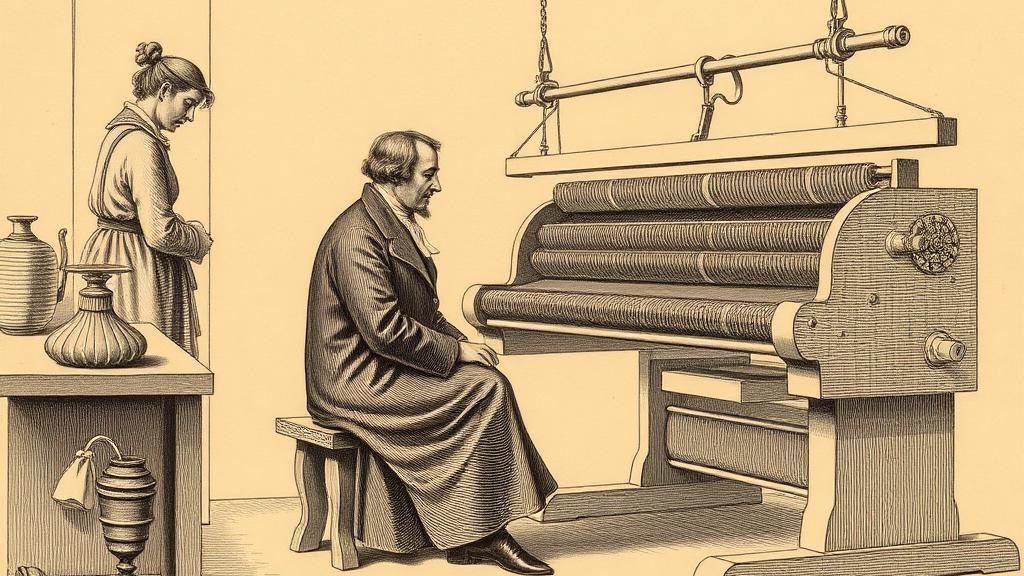
The Jacquard loom, or how a silk weaver programmed a machine
The silk merchants of Lyon had a problem in 1804, and it was skilled labor. Producing brocade — the heavy, elaborately patterned silk that draped the chairs of every noble house in France — required a “drawboy,” a child who sat atop the loom and manually lifted the correct warp threads on each pass of the shuttle. Each pattern row had to be recalled from memory. One distracted drawboy, and the peacock feather on the marquis’s upholstery grew an extra eye in the wrong place.
Joseph Marie Jacquard, a Lyon weaver’s son who had already spent fifteen years tinkering with looms, had seen enough peacock mishaps. In 1804 he completed an attachment that replaced the drawboy entirely: a chain of stiff pasteboard cards, each one punched with holes in precise positions. As the loom advanced one card at a time, hooked needles passed through the holes and lifted only the threads that the pattern called for. The holes were the instructions. The machine followed them exactly, every time. Wikipedia
Napoleon Bonaparte, touring Lyon in 1805, was impressed enough to grant the patent and award Jacquard a pension. The local weavers were less delighted. They rioted — twice — burned several of the machines, and reportedly threw Jacquard himself into the Saône. The guild logic was sound: one Jacquard loom did the work of the drawboy, and unskilled workers could now produce patterns that had taken years of training to memorize. By 1812, Lyon had roughly 11,000 of the machines in operation. Computer History Museum
The best evidence of what the loom could actually do hangs, framed, in the Science Museum in London. It is a portrait of Jacquard himself — woven in black and gray silk, in enough detail to see the wrinkles beside his eyes. The portrait required 24,000 punched cards to produce. Charles Babbage acquired a copy, kept it in his London drawing room, and showed it to every visitor who would listen. He called it the finest illustration he knew of the difference between a mechanism and a program: the loom did not know it was weaving Jacquard’s face. It was simply executing a sequence of instructions stored outside itself.
Babbage was already designing his Analytical Engine by the 1830s, and he borrowed the punched-card mechanism wholesale. Ada Lovelace, writing her famous notes in 1843, put it plainly: “The Analytical Engine weaves algebraical patterns just as the Jacquard-loom weaves flowers and leaves.” Half a century later, Herman Hollerith used the same principle — holes in cards, read by needles and electrical contacts — to tabulate the 1890 U.S. Census in a fraction of the time the manual count had taken in 1880. Hollerith’s Tabulating Machine Company eventually merged into a larger entity that renamed itself IBM in 1924. Britannica
What Jacquard had invented, without quite meaning to, was the stored program. The design and the machine that executed it were separate objects. You could change one without rebuilding the other. You could store a pattern, ship it across a continent, run it a thousand times, and never once rely on a trained human to hold it in memory. That idea — instructions as data, held outside the machine — is the single conceptual thread that runs from a Lyon silk loom in 1804 to every compiler, every operating system, every server farm humming quietly somewhere in a field right now.
The drawboys found other work. The cards just kept multiplying.
Sources
- Jacquard machine — Wikipedia — mechanism description, Napoleon’s patent, Lyon riots, spread to 11,000 looms by 1812
- Computer History Museum: Punched Cards Control Jacquard Loom — technical detail on how cards controlled warp threads, significance for data storage history
- Jacquard loom — Encyclopaedia Britannica — Hollerith and IBM lineage, Ada Lovelace’s quotation, broader computing impact
- Joseph Marie Jacquard — Wikipedia — biographical detail, the 24,000-card portrait