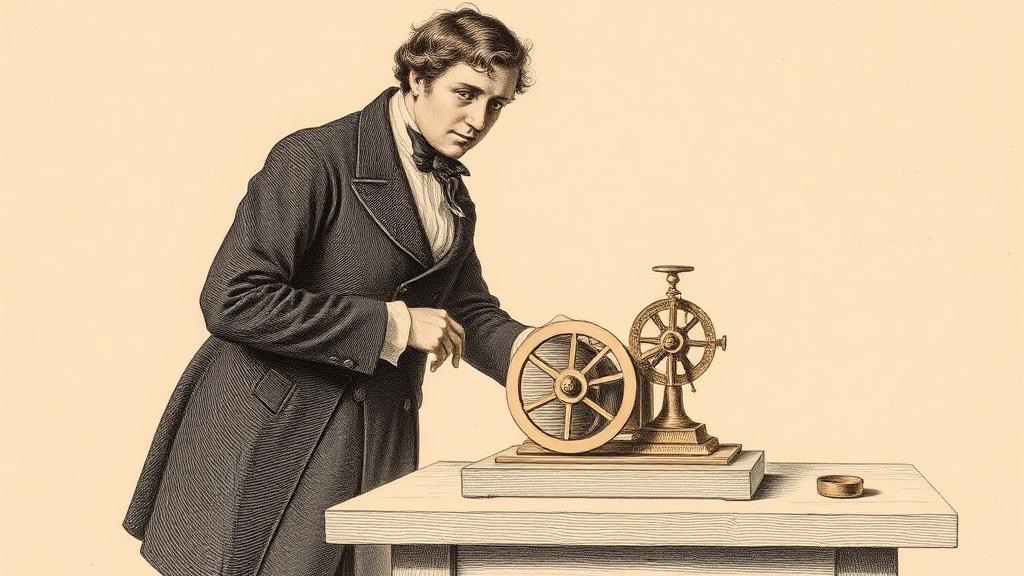
Babbage's Difference Engine, or the most expensive one-seventh of a calculator
In the summer of 1821, Charles Babbage and John Herschel sat across a table in London cross-checking the arithmetic in a set of astronomical tables. Both were founding members of the Royal Astronomical Society. Both knew exactly what errors in those tables cost — ships ran aground on bad navigation, cargoes insured against the wrong risks. When they found another mistake, Babbage looked up and said: “I wish to God these calculations had been executed by steam.” Herschel replied: “It is quite possible.”
That exchange began one of history’s most expensive arguments between ambition and manufacturing.
Babbage’s design — he called it the Difference Engine — ran on the method of finite differences, a mathematical trick that reduces complex polynomial calculations to nothing but repeated addition. No multiplication, no division, no human judgment at each step: just a gear advancing by a fixed increment, carrying a digit, resetting. By 1822 he had a small working prototype, and on June 14 of that year he presented it to the Royal Astronomical Society in a paper titled “Note on the application of machinery to the computation of astronomical and mathematical tables.” The little machine calculated the first thirty values of x² + x + 41 — a formula Babbage favored because it generates a long run of prime numbers — at thirty-three digits per minute, without error.
The British government noticed. Errors in printed navigation tables were estimated to have cost the Crown two to three million pounds in wrecked ships and bad calculations. In 1823, Parliament provided £1,700 to start construction of a full-scale machine that would automate mathematical table-making permanently. Computer History Museum
The full design called for roughly 25,000 precision components, a machine eight feet tall and four tons heavy. Babbage contracted master engineer Joseph Clement to fabricate the parts. Clement was, by all accounts, exactly as good as he was expensive. By 1832 he had produced about 2,000 of the required components — one-seventh of the whole — which Babbage assembled into a demonstration section. It ran without flaw. Then Babbage and Clement had a dispute over ownership of the specialized tools Clement had built to spec. Clement stopped work, took the tools, and left. Construction never resumed. Science Museum
The government killed the project in 1842, after eighteen years and £17,500 — enough, by contemporary reckoning, to have bought twenty-two brand-new locomotives from Robert Stephenson’s factory. The engine meant to eliminate human error from mathematics had itself become a case study in a project nobody knew how to cancel early.
The demonstration section Clement assembled still runs. It sits in the Science Museum in London and operates on demand, as precisely today as it did in 1832. In 2002, the museum built a complete Difference Engine No. 2 from Babbage’s revised 1847 plans, using manufacturing tolerances his era couldn’t achieve — and that machine worked too. The design had never been the problem.
Babbage had already reached that conclusion by the mid-1830s. While Clement’s unfinished parts sat in storage, he was filling notebooks with something the Difference Engine couldn’t do: multiply, remember its own state, and follow different instructions depending on intermediate results. He called it the Analytical Engine — a machine with a memory, a processor, and something like a program. The calculator was the proof. The computer was what he was actually building toward.
Sources
- Difference engine — Wikipedia — Method of finite differences, the 1822 prototype, x² + x + 41, construction and funding history.
- The Engines — Computer History Museum — Full design specifications, government funding timeline, the shift to the Analytical Engine.
- Charles Babbage’s Difference Engines — Science Museum — The Clement dispute, the £17,500 final bill, the 2002 working reconstruction.