The Mesopotamian shekel, or how a weight became money
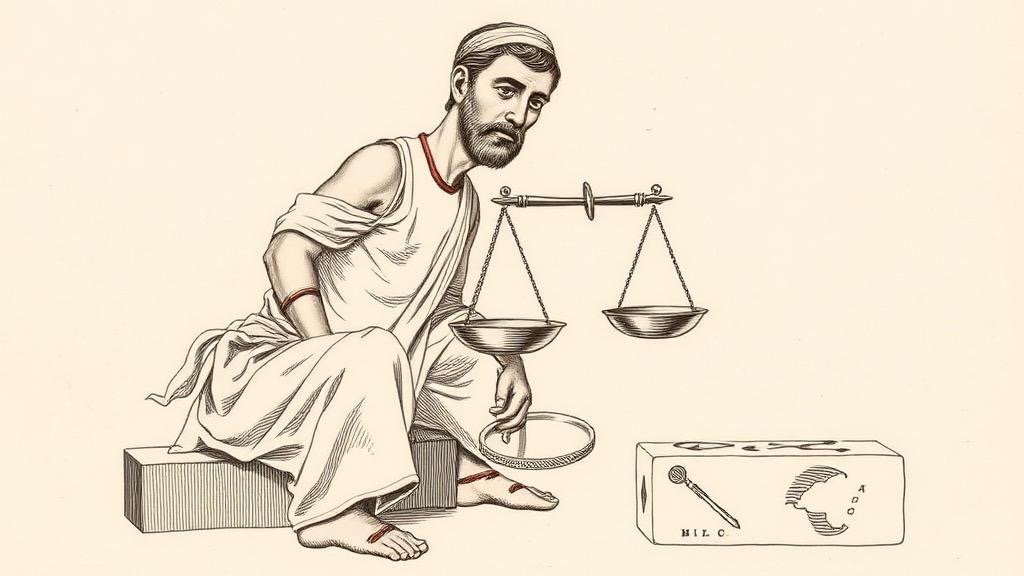
A merchant in the city of Ur, around 2500 BCE, carried his money in a small cloth pouch — not coins, but a coil of silver, twisted like a thick ring, already showing the dark nicks where bits had been broken off to make previous payments. When he needed to settle a debt, he pinched off another sliver, dropped it on a bronze pan scale, and adjusted until the balance swung even against a polished hematite weight roughly the size of a fig. That weight had a name that would outlive every city and dynasty it served: the shekel.
The word descends from the Akkadian šiqlu, from a Proto-Semitic root meaning “to weigh.” Its Sumerian equivalent was gin2. The shekel entered the written record around 2150 BCE under the Akkadian king Naram-Sin, though the silver standard it represented was already old — traceable to at least 3000 BCE, when Mesopotamian city-states first adopted silver as the medium best suited to settling debts across long distances.
The system ran on a precise hierarchy: one talent of silver divided into sixty minas; each mina divided into sixty shekels; each shekel weighing approximately 8.33 grams — about what a skilled laborer earned in one month. In the Ur III period (21st century BCE), that single shekel bought roughly 300 liters of barley, nearly a full year’s grain for one person. Over 100,000 cuneiform tablets survive from that dynasty alone, averaging a thousand per year — an archive of prices, debts, and wages that reads like a very old spreadsheet.
The Laws of Eshnunna, compiled around 2000 BCE for a city-state just north of Sippar, set fines in shekels for a comprehensive catalogue of injuries. Biting off someone’s nose: sixty shekels. A slap to the face: twenty. A broken finger: presumably something in between, though the relevant tablet is silent on the matter. Another document from Sippar records a woman purchasing land by handing over a silver ring worth sixty months’ wages — a transaction requiring no banker, no intermediary, and no shared history between buyer and seller. The weight spoke for itself.
That is exactly what the shekel unlocked. Before it, exchange meant barter: chains of bilateral deals between people who happened to want each other’s goods. The historian Marvin Powell described the shift plainly: “Silver in Mesopotamia functions like our money today. It’s a means of exchange.” What it exchanged was more than goods — it replaced trust between strangers with trust in a standard. A calibrated stone weight and a level pan scale were enough.
Ordinary people rarely touched silver; their daily commerce ran on barley, copper, and tin. But silver set the prices. Every basket of grain, every hired laborer, every bolt of wool was understood, in the ledgers of the temples and palaces, as some fraction of a shekel.
The coin came along five hundred years later, in Lydia, already stamped with a ruler’s face as an official guarantee. But the guarantee the shekel had already offered was simpler and, in the long run, more durable: a fixed weight, a calibrated stone, and a scale that didn’t care who you were.
Sources
- Shekel — Wikipedia — Etymology (šiqlu/gin2), first attestation under Naram-Sin of Akkad, weight standards and historical distribution.
- Money in Ancient Mesopotamia — Facts and Details — Shekel weight (8.33 g), one month’s labor equivalence, Laws of Eshnunna fines, Sippar land purchase tablet, Marvin Powell quote.
- Silver in Sumer — Thin End of the Wedge — Ur III documentation scale (100,000 tablets), 300-liter barley exchange rate, silver circulating as rings and coils, silver’s Anatolian origin.