The bridge at Girsu, or the world's oldest crossing
Sometime around 2900 BCE, a canal thirty meters wide ran through the center of Girsu — the Sumerian megacity that sat roughly midway between modern Baghdad and Basra, home to the war god Ningirsu and tens of thousands of people who needed to reach his temple. The canal was inconvenient. The Sumerians built a bridge.
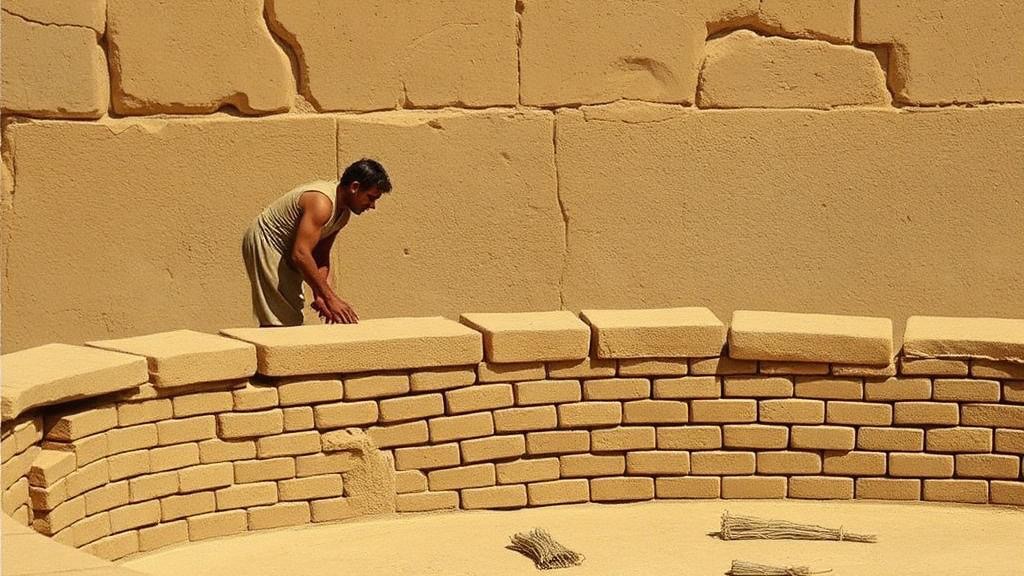
What they built does not look like what we picture when we think of bridges. The Girsu bridge is a massive, squat structure: two curved mud-brick walls, each about forty meters long, ten meters wide, and three meters tall, arranged in opposing arcs that pinch the canal down to a five-meter passageway (Madain Project). The bricks are fired and sheathed in bitumen for waterproofing — a material the Sumerians used with the same matter-of-fact confidence that later builders would apply to Roman cement. Foundation bricks are stamped with dedications to Ningirsu. In Sumer, even a canal crossing was a religious act.
The pinched passage did more than let people cross. By narrowing a thirty-meter channel to five meters, the structure created what engineers today call a Venturi effect — the constricted flow accelerated, scoured the canal bed, and fought the silt that was the permanent enemy of every irrigation canal in Mesopotamia (Arkeonews). Giovanni Battista Venturi would not formulate the underlying principle until 1797. The Sumerians were working with it in 2900 BCE, stamping prayers into the brickwork as they went.
French archaeologists dug the structure up in 1929 and were promptly confused. De Genouillac and Parrot catalogued it as a water regulator, a shrine, or a pseudo-tomb — three distinctly different guesses that nonetheless shared the quality of being wrong. The bridge sat open and unprotected for nearly ninety years until the British Museum’s Girsu Project, beginning in 2017, combined photogrammetry surveys with declassified 1960s satellite imagery and confirmed what it actually was: a bridge (British Museum Girsu Project). The oldest one on earth had spent nine decades being called something else.
There is a detail that gives the structure a darker hue. Inscribed tablets from Girsu suggest that toward the end of the city’s life, its inhabitants watched their canals dry up and silt shut, one by one. The bridge — with its hydraulic narrowing, its prayer-stamped bricks, its desperate optimization of a dwindling water supply — may represent a last attempt to hold the system together before it failed entirely. If so, the world’s first bridge was also, in some sense, a last stand.
The moment a civilization commits to a permanent crossing — not a ford, not a felled tree, but a fired-brick structure intended to outlast its builders — it makes a claim about the world: that both banks belong to the same city. The bridge at Girsu was the first time anyone made that claim. Every span built since has been that same claim restated, in materials the Sumerians never imagined.
Sources
- Madain Project: Girsu Bridge — Dimensions, construction materials, dedicatory inscriptions, excavation history by De Genouillac and Parrot in 1929.
- British Museum Girsu Project — Confirmation as the world’s oldest bridge via photogrammetry and declassified satellite imagery, preservation work since 2017.
- Arkeonews: Girsu excavations — Venturi effect function, canal dimensions, inscribed tablet evidence of the city’s water crisis.