The abacus, or how humanity learned to compute with pebbles
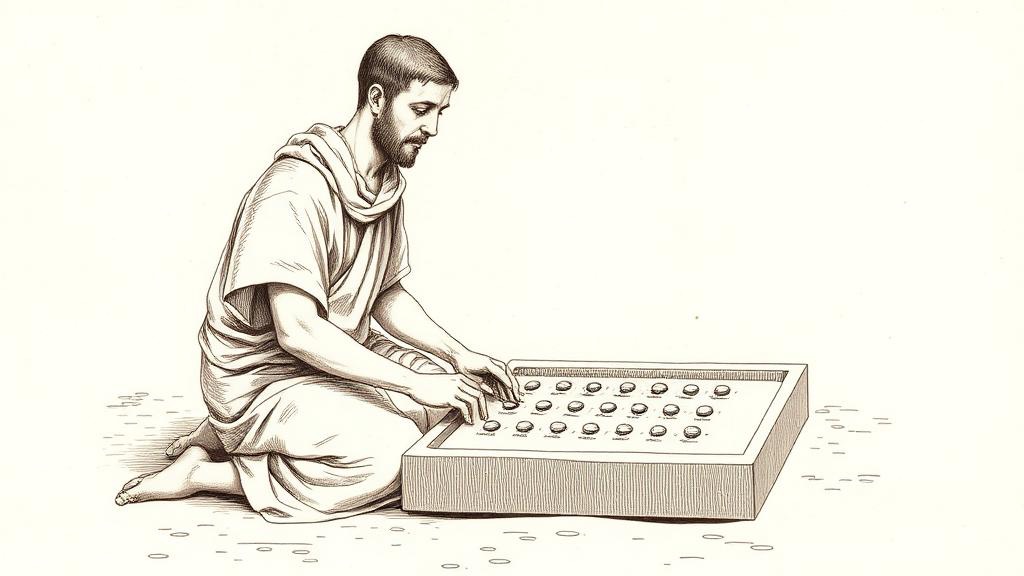
Picture a Sumerian scribe, somewhere in the baked-mud sprawl of a city like Uruk around 2300 BCE, drawing columns in a tray of sand. Each column stands for a power of sixty — because in Mesopotamia, of course it does — and into each column he drops a pebble, then another, then another, until the columns tell him how many bushels of barley the temple is owed this month. He is, as far as we can tell, performing the oldest surviving act of computing. His tray has a name that will outlive him by four thousand years: the abacus.
The word itself is a small fossil. It comes down to us through Latin from the Greek abax, “board,” which most etymologists trace further back to a Semitic root meaning “dust” — a quiet echo of those original sand-strewn counting trays (Britannica). Before the device became the bead-and-wire contraption we recognise today, it was literally a patch of dirt you could wipe clean and start over.
The earliest physical abacus we actually have is later and Greek: the Salamis Tablet, a slab of white marble about 149 cm long, dug up on the island of Salamis in 1846 and now in the National Museum of Epigraphy in Athens (Wikipedia). It dates from around 300 BCE, is ruled with careful parallel lines, and was almost certainly used by merchants and money-changers pushing pebbles around in the agora. It is, in effect, a 23-century-old spreadsheet.
From there the abacus radiates outward with the confidence of a good idea. The Romans grooved it into bronze and carried it with the legions. By the second century BCE the Chinese had the suanpan, with its characteristic two-beads-above, five-beads-below layout. In the 14th century the suanpan crossed the sea to Japan and, slimmed down to one-bead-above and four-beads-below, became the soroban. Russia, characteristically, went its own way: the schoty stands upright, with ten beads per wire, and was apparently so effective that even the 1874 arithmometer, a cutting-edge mechanical calculator, failed to dislodge it (Wikipedia).
Here is the part that tends to break people’s brains. On November 12, 1946, in the Ernie Pyle Theatre in occupied Tokyo, the US Army newspaper Stars and Stripes staged a contest between the past and the future. In one corner: Private Thomas Nathan Wood of the 20th Finance Disbursing Section, a decorated expert on an electric calculator. In the other: Kiyoshi Matsuzaki, a clerk from the Japanese Ministry of Postal Administration’s Savings Bureau, armed with a wooden soroban. Twenty-five hundred GIs watched. The soroban won, four rounds to one — beating the machine at addition, subtraction, division, and a composite problem, losing only at pure multiplication (History of Information). The Bronze Age had a pretty good last laugh on the Industrial Age.
What the abacus actually unlocked is bigger than any single calculation. It taught humanity a lesson that every computer since has inherited: that position matters. A bead in the fives column means something completely different from the same bead in the ones column. This is place-value arithmetic made physical — the ancestor of every register in a CPU, every digit in a float, every bit in RAM. It also taught us that you could separate the what of a calculation (the numbers, the rules) from the who (the person). Any trained operator, given the same beads and the same rules, gets the same answer. That is the quiet, radical premise of computing: a procedure is a thing you can hand to someone else — or eventually, to something else.
Four thousand years later, we are still sliding beads. The beads have simply gotten very, very small.
Sources
- Abacus — Wikipedia — Sumerian origins c. 2700–2300 BCE, the Salamis Tablet, regional variants (suanpan, soroban, schoty), etymology.
- Abacus — Encyclopaedia Britannica — Babylonian origin, Semitic “dust” etymology, evolution from sand-tray to wire-and-bead, significance as ancestor of the modern calculator.
- A Soroban Beats an Electric Calculator — History of Information — Details of the 1946 Tokyo contest between Kiyoshi Matsuzaki and Private Thomas Nathan Wood.