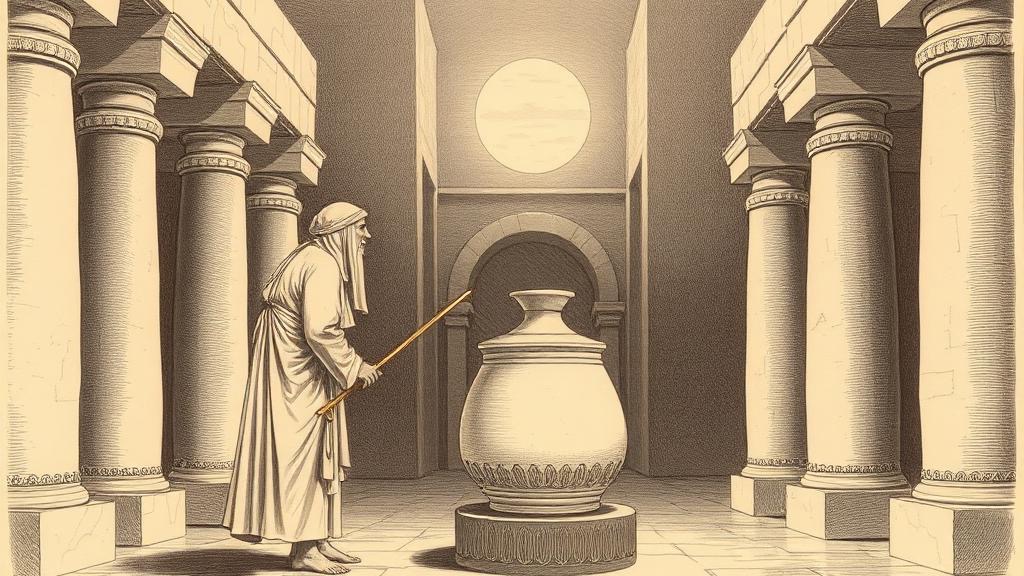
The Egyptian clepsydra, or how priests told time without the sun
Somewhere inside the temple complex at Karnak, around the 15th century BCE, a priest had a problem. The ritual had to begin at the third hour of the night, and the stars were hidden behind cloud. The sun was gone, the shadow clock was useless, and the gods were not known for their patience with late offerings. Into this problem, somebody poured water.
The device they invented is called a clepsydra — from the Greek for “water thief” — though the Egyptians had their own word for it: mrht, “instrument for telling time at night.” The earliest attribution goes to a court official named Amenemhet, who served three successive pharaohs around 1500 BCE (Ahmose I, Amenhotep I, and Thutmose I) and left a record of his invention in his tomb inscription, noting that nights grew and shrank through the year and that he had built something to track them (Ancient World Magazine).
The oldest physical clepsydra to survive was found in 1904 inside the Temple of Amen-Re at Karnak. It dates to the reign of Amenhotep III, roughly 1391–1353 BCE, and it is carved from a single block of alabaster — the same white stone the Egyptians reserved for their finest vessels. Shaped like a wide, slightly tapered bucket, it holds water and bleeds it slowly through a small hole near the base, where it trickles out beneath a carved baboon (Egypt Museum). A priest peered inside, spotted the waterline against the nearest notch, and knew the hour.
The interior is marked with twelve columns of notches, each column corresponding to a calendar month. The detail repays attention: Egyptian hours were not fixed at sixty minutes but were a twelfth of the available night, which at Karnak ranges from roughly ten modern hours in winter to fourteen in summer. The hours themselves lengthen and shorten through the year. The twelve columns handle that variability — the notch spacing differs from month to month, so the priest simply consulted the column for the current month rather than a single fixed scale. It is a calibrated instrument, not a dripping curiosity (Science Museum Group).
Clepsydras also moved well beyond the sanctuary. Egyptian courts used them to regulate the length of speeches — cutting off the flow when a lawyer’s allotted time expired — which makes the clepsydra the direct ancestor of every parliamentary timer, every courtroom countdown clock, and every chess-clock buzzer ever built (Wikipedia). The management of time as a civic resource, not merely a religious one, starts here.
The conceptual shift was more important than the mechanism. A shadow clock measures the sun: it stops working the moment that relationship breaks down — clouds, nightfall, an interior room. A water clock measures duration. It can run inside a windowless chamber, through an overcast winter night, on the deck of a Nile barge, wherever a vessel and a small hole can be managed. Detaching the measurement of time from the sky made time portable — something that could be taken into any room a priest, a judge, or a merchant needed it.
Around 250 BCE, the Alexandrian engineer Ctesibius would add a float, a pointer, and a gear-driven dial, turning the dripping bucket into a self-reading instrument that adjusted automatically for seasonal hour lengths. But the premise — that falling water could stand in for the moving sun — was Amenemhet’s.
The sun tells you where you are in the day. Running water tells you how long you have been there.
Sources
- Water clock — Wikipedia — Origins under Amenhotep III, Egyptian court use, Greek inheritance.
- Clepsydra of Karnak — Egypt Museum — Physical description of the alabaster vessel, the twelve-column interior, the baboon drain figure, discovery in 1904.
- Egyptian Water Clock — Science Museum Group Collection — Design details and variable-hour calibration.
- Water Clocks in Antiquity — Ancient World Magazine — Amenemhet attribution and tomb inscription, c. 1500 BCE.