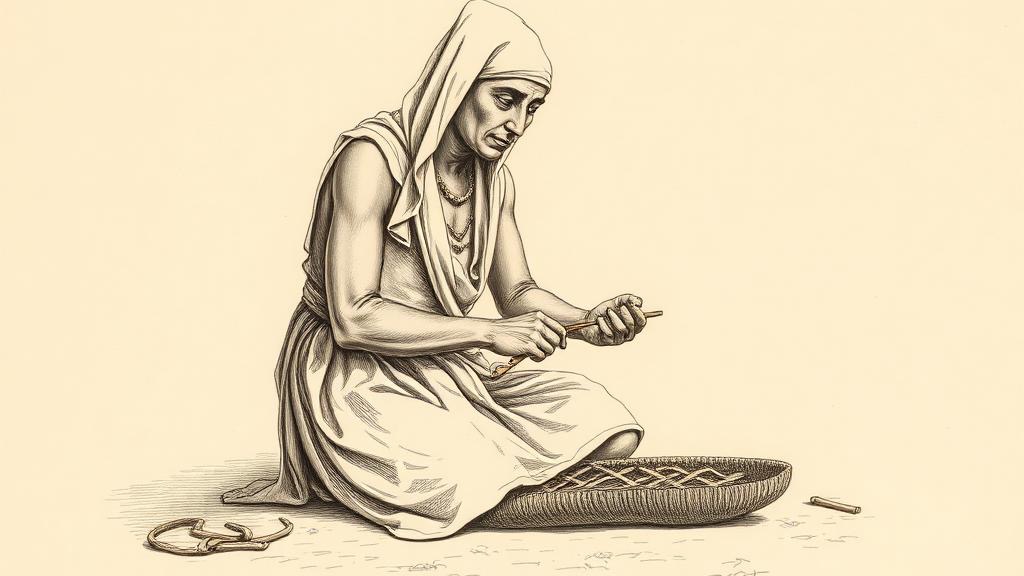
Egyptian papyrus sandals — footwear as social code, c. 1500 BCE
In the court of Tutankhamun, one of the most coveted titles at the pharaoh’s side was not general, not vizier, but sandal bearer — the official whose sole duty was to carry the king’s footwear between rooms and kneel to fasten it onto the royal feet. The position sounds menial until you realize it placed you within arm’s reach of a living god.
By the New Kingdom, roughly 1550–1070 BCE, sandals had become one of ancient Egypt’s sharpest social instruments. Most Egyptians still went barefoot — not only from necessity, but from protocol. Appearing unshod before a superior was a mark of deference. Entering a temple required bare feet. The sandal you were permitted to wear, and the one entombed with you when you died, both said something precise about who you were.
The standard construction was deceptively simple. Papyrus stems or palm leaves were plaited in tight coils — the same technique used for baskets — then layered and shaped into a sole. A loop of plant fiber or leather threaded between the first and second toes, anchored by a strap running back around the heel. Craftsmen also used halfa grass (Desmostachya bipinnata), a tough Nile-valley reed that resists decay; much of what survives in museums today was made of it. For the wealthy, leather replaced fiber. For royalty, leather was gilded, painted, or inlaid with semiprecious stone.
The richest archive we have comes from one tomb. When Howard Carter opened Tutankhamun’s burial chamber in 1922, he found more than eighty pairs of sandals — ranging from plain woven palm-leaf construction to gold reproductions so precise that the stitching lines of the sewn originals were embossed into the metal. One pair depicted bound captives on the inner sole: the Nine Bows, a traditional symbol of Egypt’s enemies. Every step Tutankhamun took, he was crushing Nubia and Libya underfoot. Archaeologist André J. Veldmeijer, who catalogued the collection, notes that some pairs show strap configurations seen nowhere else in Egyptian footwear, suggesting they were custom-fitted for a single wearer.
Priests operated under a different constraint. Religious protocol forbade leather sandals during funeral rites — only papyrus. Animal-skin varieties, acceptable for daily life and for soldiers, became ritually impure in the presence of Osiris. Material carried liturgical weight that wealth could not override.
What the Egyptian sandal did, more completely than any footwear before it, was turn the foot into legible text. Ötzi’s layered bearskin-and-deerskin construction had solved a thermal problem. The Egyptian sandal solved a hierarchical one: who may cover their feet, in what material, decorated how, and by whom fastened onto whose feet. The sandal bearer’s title was not a servant’s rank — it was a position adjacent to power, and everyone in that court could read exactly what it meant.
The calculus would change shape with every civilization that followed. The logic has not.
Sources
- Papyrus Sandals — World History Encyclopedia — Papyrus construction and coiled-basketry technique.
- King Tut’s Footwear — ZME Science — Tutankhamun’s 80+ pairs, gold construction, Nine Bows iconography, Veldmeijer catalogue.
- Ancient Egyptian Footwear at the Bata Shoe Museum — Nile Scribes — Ptolemaic and New Kingdom examples, status signalling, gilded cartonnage foot cases.
- The Sandals of Ancient Egypt — Historical Eve — Materials survey, priestly papyrus-only protocol, color symbolism and ritual significance.