Cuneiform: the script that could say your name
Around 2285 BCE, in the city of Ur, a high priestess named Enheduanna closed a poem by pressing her own name into the clay. She was the daughter of Sargon of Akkad, the most powerful king in the known world, but what she left behind was something no sovereign had yet managed: the first named attribution of authorship in recorded history (World History Encyclopedia). That it survives at all is a consequence of the script she used — one that had been quietly transforming the ancient world for nine centuries before she picked up her stylus.
Scribes in Uruk began the change around 3200 BCE. The accounting tablets of the previous era had been incised with a round stylus. Someone swapped it for a cut reed pressed at an angle — and the result was the wedge-shaped impression that gives the system its modern name. Cuneiform comes from the Latin cuneus, “wedge” (Britannica). It was faster, produced sharper marks, and scaled to the demands of a civilization that now needed to record contracts, legal codes, and diplomatic correspondence as well as grain shipments.
The early sign inventory ran to more than a thousand distinct characters, pared down to around six hundred by the 24th century BCE (Wikipedia). But the more consequential change was phonetic. In Sumerian, the word for “arrow” (ti) happened to sound like the word for “life” (ti). So a scribe who needed to write “life” — an abstraction impossible to draw — simply pressed the sign for arrow and meant something it didn’t picture. From that small trick, cuneiform learned to spell names, record verbs, and eventually compose poetry.
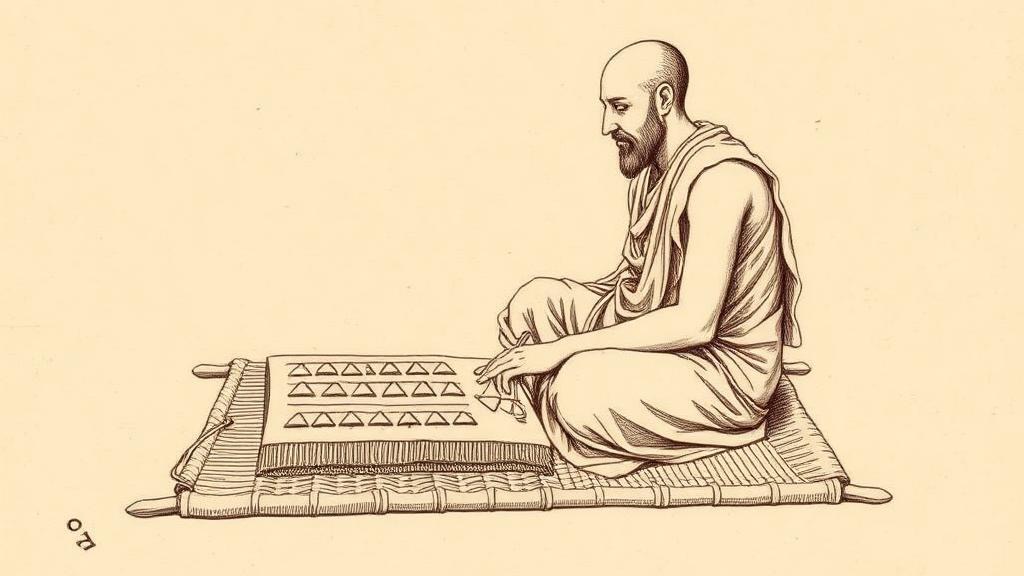
Learning to use this system took roughly twelve years. In Mesopotamian cities, the edubba — the “House of Tablets” — trained scribal students from around age eight, grinding through sign lists, legal formulae, and mathematical tables before reaching literature. The prestige was considerable; the dropout rate presumably higher.
Which makes Enheduanna’s surviving poems all the more striking. As high priestess of the moon god Nanna, she composed two cycles of hymns and inserted her own name into the closing lines: “I, Enheduanna, the high priestess, entered the holy gipar in your service.” Whether she pressed the clay herself or dictated to a scribe, she was the author, and she said so. No earlier text names its maker.
Cuneiform went on to become the first genuinely international script. Akkadians, Hittites, Babylonians, and the diplomats of a dozen city-states adapted it to their own languages, pressing Semitic, Indo-European, and Elamite words into the same wedge-shaped marks. The latest known cuneiform tablet, an astronomical almanac from Uruk, dates to AD 79 — the same year Vesuvius buried Pompeii (Wikipedia). The script that began as a tool for counting barley outlasted the Roman Republic by five centuries.
The alphabet, when it came, would compress all of that to twenty-two signs. But the premise — press a mark, mean a sound — was set here, in Uruk, with a cut reed and a lump of wet clay.
Sources
- Cuneiform — Wikipedia — sign inventory reduction, phonetic development, linguistic spread to Akkadian and Hittite, last known tablet AD 79/80.
- Enheduanna — World History Encyclopedia — biography, first named author, hymns to Inanna and the Temple Hymns.
- Cuneiform — Encyclopaedia Britannica — wedge etymology, reed stylus technique, administrative to literary transition.