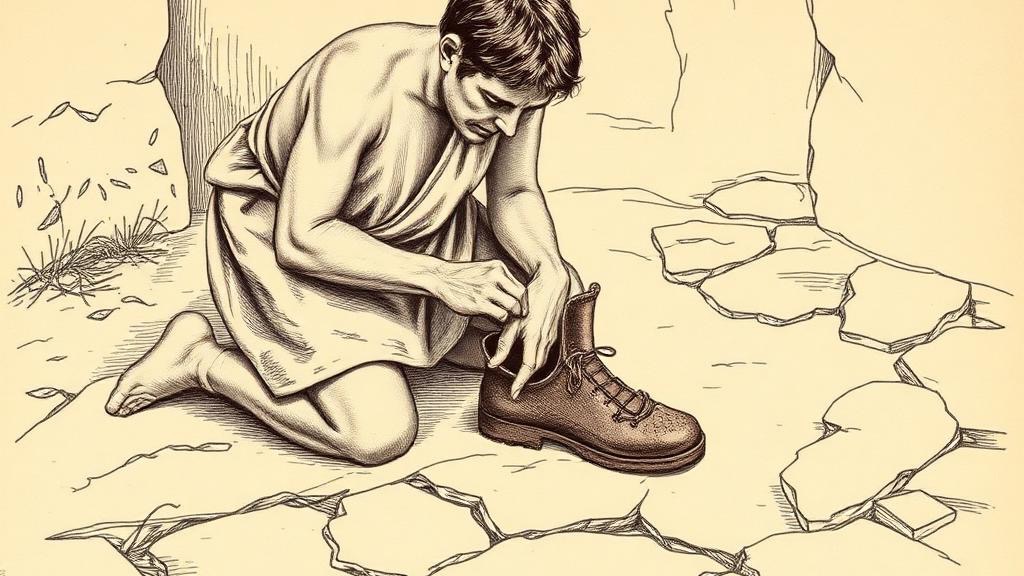
Ötzi's shoes, or the engineering in a glacier
When Helmut and Erika Simon spotted a face and pair of shoulders projecting from a glacier near the Tisenjoch pass in the Ötztal Alps on September 19, 1991, they assumed they had found a recently dead mountaineer. The Austrian rescue team that arrived made the same call — and attempted to free the body with a pneumatic drill before bad weather sent them home. It took carbon dating to establish that the man had been lying there since approximately 3250 BCE.
He is known now as Ötzi. He was found at 3,210 meters above sea level, 92.56 meters inside Italian territory, frozen in a glacial hollow with his possessions still arranged around him. Among those possessions: the most technically sophisticated shoes recovered from the ancient world.
The shoes Ötzi died in are an engineering document. Three species contributed to a single pair: bearskin for the soles, deer hide for the uppers, calfskin strips for the bindings that laced upper to sole. Inside, a cage of woven linden bark held a padding of Alpine grasses — later analysis identified several species, including Brachypodium pinnatum, which grows only in valley floors, not at altitude. The evidence implies that Ötzi replenished the grass as he moved between elevations: fresh insulation packed in the valley, wearing thin by the pass. The bearskin sole, fur turned inward, distributed pressure evenly across the foot. Raffia strings pulled the whole assembly tight. It is layered construction — waterproof shell, insulating core, moisture-wicking liner — in a format that has not been improved upon in principle.
The leather had been tanned with a mixture of beef brain and pork liver, then smoke-dried — a method the South Tyrol Museum of Archaeology in Bolzano identifies as one that stabilizes the collagen and yields soft, workable hide. Ötzi’s shoemaker understood the chemistry by result rather than by theory, which amounts to the same thing.
In September 2001, Dr. Petr Hlavácek built an exact replica using flint tools and primitive tanning methods, then sent twelve mountaineers up Mount Similaun at 3,599 meters in temperatures between -5°C and -10°C. The Bata Shoe Museum’s account of the expedition is spare: not one blister. Feet stayed warm and dry. A 5,300-year-old design, reconstructed from first principles and tested at altitude, performed exactly as the original maker intended.
When Ötzi was found, the right shoe was still on his foot. The left had partly deteriorated; only the bark mesh survived. Whoever assembled these shoes built them to last — and in the most literal sense available to the archaeological record, they did.
The multi-layer logic of Ötzi’s construction — outer shell repels water, middle layer holds warmth, inner layer manages moisture — runs unbroken through every serious cold-weather boot made today. The bearskin is gone; the architecture remains.
Sources
- Ötzi — Wikipedia — Discovery date and circumstances, location at Tisenjoch pass, death date estimate (3239–3105 BCE), general overview of clothing.
- Clothing — South Tyrol Museum of Archaeology — Materials breakdown: bearskin soles, deerskin uppers, calfskin bindings, linden bark mesh, grass species identification, tanning method with beef brain and pork liver.
- Otzi the Iceman — Bata Shoe Museum — Dr. Hlavácek’s 2001 replica expedition on Mount Similaun; performance results.