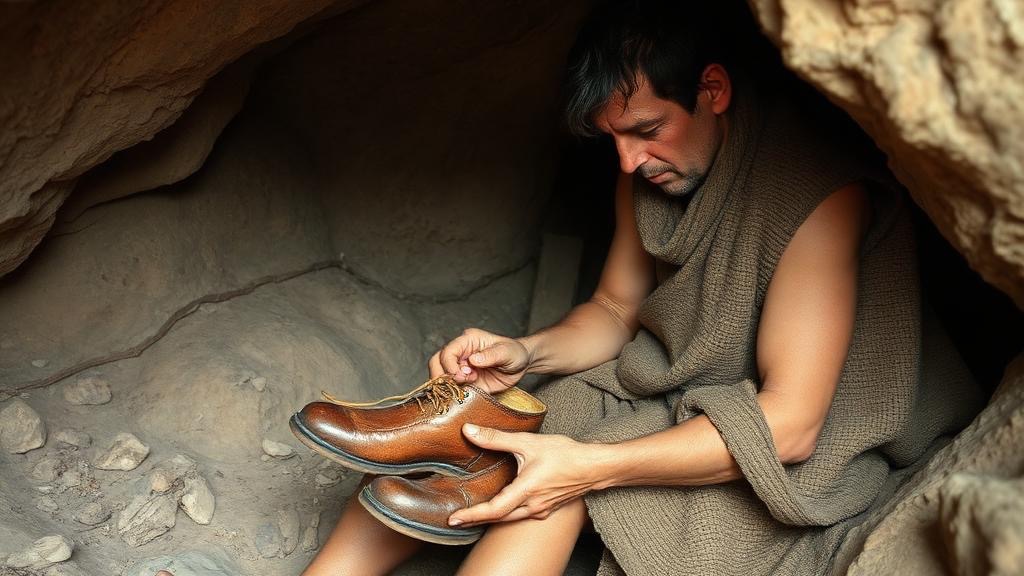
The Areni-1 shoe, and the art of making leather last
In the winter of 2008, a graduate student named Diana Zardaryan was excavating a shallow pit inside Areni-1, a limestone cave in the Vayots Dzor highlands of southern Armenia, when she found a shoe. It was sitting upside down beneath a broken ceramic bowl, packed with dried grass, its leather laces still threaded through their eyelets. It looked like it had been set down last week.
The cave is old beyond reckoning as an occupied site, but the shoe itself dates to approximately 3500 BCE — the early Copper Age, a moment when humans in this part of the world were beginning to work metal. Radiocarbon testing by laboratories at Oxford and the University of California confirmed the date, placing it roughly two centuries older than Ötzi the Iceman’s considerably more famous footwear. Boris Gasparyan of Armenia’s Institute of Archaeology and Ethnography led the excavation, with Ron Pinhasi of University College Cork and Gregory Areshian of UCLA as co-directors.
The shoe is modest. About a women’s U.S. size 7, it was cut from a single piece of cowhide, tanned, and shaped to a foot, then laced at front and back seams with a thin leather cord. Inside: grass, either as insulation against the Armenian highlands’ considerable cold, or simply to hold its shape in storage. Pinhasi noted that cutting the hide into layers and tanning it was probably quite a new technology at 3500 BCE. Whoever made this shoe was working at the edge of what their era knew how to do with a dead cow.
The shoe was published in 2010, and when the photographs circulated, Manolo Blahnik — the shoe designer whose stilettos run to several hundred dollars a pair and whose clients include most of Hollywood — studied the images and remarked on how much it resembled a modern shoe. He was not wrong. Swap the leather lacing for a synthetic cord, place it in a boutique window beside hand-sewn moccasins, and nobody pauses. Five and a half thousand years of accumulated ingenuity have not fundamentally altered the geometry of leather shaped around a human foot.
The cave was not merely a shoe cache. Areni-1, from the same general era, also yielded the oldest known winemaking operation on Earth — fermentation vats, a wine press, storage jars. The shoe was found alongside wild goat horns, red deer bones, and the inverted broken bowl. That arrangement may be deliberate; archaeologists suspect the deposit held ritual significance. Whoever left the shoe was not simply tidying up.
The Areni-1 shoe matters not because it tells us when humans first covered their feet — the Fort Rock sandals, five thousand years older, settle that — but because it tells us when they began to care about fit. A single piece of hide shaped to one specific right foot is not a generic covering. It is a custom item, sized and formed to a particular person. That is tailoring. The tradition it inaugurated — shaped leather, closed seams, laced closure — would run essentially unbroken from this highland cave through Roman cobblers, medieval cordwainers, and the factory floors of nineteenth-century Lynn, Massachusetts.
The shoe is now in the History Museum of Armenia in Yerevan. Its geometry — hide, seam, lace — has not substantially changed in the five and a half millennia since it was left in that pit, which says something either about the perfection of the design or the stubbornness of the foot.
Sources
- Areni-1 shoe — Wikipedia — discovery context, construction details, dating, comparisons with European shoe traditions.
- World’s Oldest Leather Shoe — National Geographic — researcher quotes from Pinhasi and Areshian, Manolo Blahnik commentary, preservation conditions.
- 5500-Year-Old Leather Shoe — History Museum of Armenia — artifact details and current display context.