The shadow clock, or how Egypt turned sunlight into hours
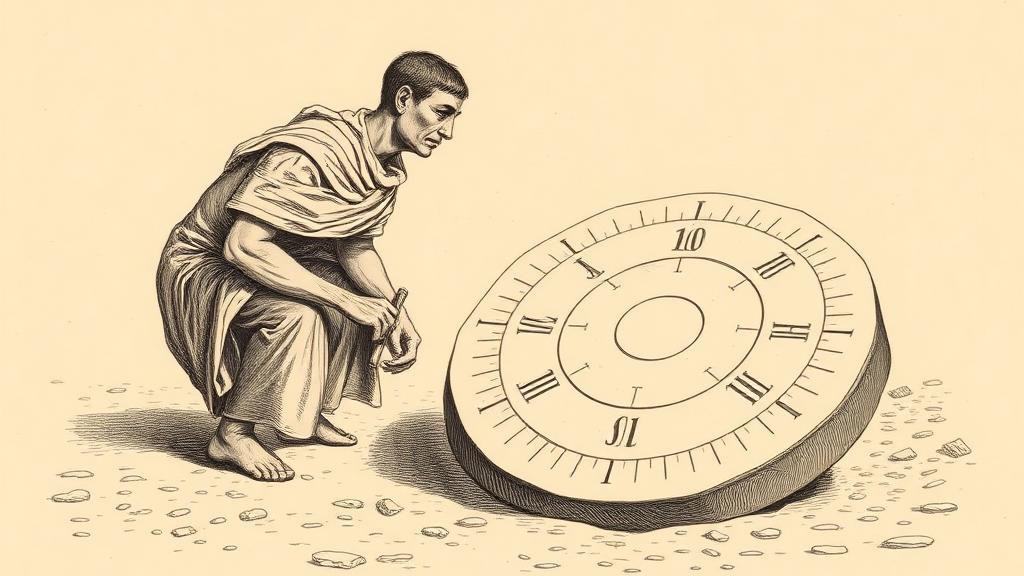
In the dry valley west of Thebes, around 1500 BCE, a stone-cutter glanced at a flat limestone disk sitting on the ground of his settlement and decided it was time to stop work. The disk had twelve sections scratched into it. The shadow had crossed enough of them. Down tools.
The limestone disk was still there in 2013, when archaeologists excavating a workers’ village near the Valley of the Kings lifted it from the rubble — one of the oldest known portable sundials in the world, and almost certainly a foreman’s timekeeping device. It did not belong to a pharaoh or a priest. It belonged to the crew.
Egypt had been reading shadows for at least two thousand years before that disk was scratched. The earliest instruments were the obelisks themselves — tapered granite pillars raised at temple gates from around 3500 BCE. Priests tracked their moving shadows to divide the day into morning and afternoon, and the noon shadow’s length told them where the year stood: shortest at the summer solstice, longest at the winter one. It was a public clock in the oldest sense — anyone in the precinct could glance at the base of the stone and know, roughly, where the sun was going.
The dedicated portable shadow clock arrived much later, around 1500 BCE. The oldest surviving example is a piece of dark schist engraved with the titles of Thutmose III — the same pharaoh who extended Egypt’s empire to the Euphrates — catalogued today as object 19744 in the Egyptian Museum Berlin. It is L-shaped. The short arm acts as the gnomon; the long arm is ruled with five marks whose spacing encodes the sun’s changing arc through the day. You set it east in the morning. At noon you spun it to face west. Five marks on polished stone, and suddenly the afternoon had structure.
Neither device gave consistent hours. Because the sun’s arc shifts through the seasons, a summer hour and a winter hour were simply not the same length. The Egyptians knew this and did not much care. They needed to know when to hold the morning rite, when to eat, when to rotate the tomb-builders’ shift. Philosophical precision was a problem for a later civilization.
The Valley of the Kings sundial captures the real stakes. Found in the dirt of a workers’ settlement — not a treasury, not a royal tomb — it was effectively an ancient time card. Hours did not exist as metaphysical categories. They existed because the state needed to know when the quarrymen should go home.
Egypt passed this instrument, the calibrated shadow, to Greece, which handed it to Rome, which carried it to every province. Pytheas of Massalia, sailing north toward the edge of the known world around 325 BCE, brought a gnomon to compare shadow lengths at different latitudes. He discovered that the same shadow that told you the time of day could also tell you where on earth you stood. A timekeeping device had quietly become a navigation instrument.
The obelisk at the temple gate was not just a monument to the pharaoh’s power. It was the first public clock — and the shadow it cast was, in some unbroken sense, the ancestor of every hour that has been scheduled, missed, or wasted since.
Sources
- History of timekeeping devices in Egypt — Wikipedia — obelisks, shadow clocks, and merkhets; mechanism and historical context.
- A Walk Through Time: Early Clocks — NIST — obelisks from 3500 BCE, portable shadow clock design, the two twilight hours.
- Reconstruction of Ancient Egyptian Sundials — arXiv/1408.0987 — details on the Berlin schist shadow clock (object 19744), Thutmose III, five-mark spacing.