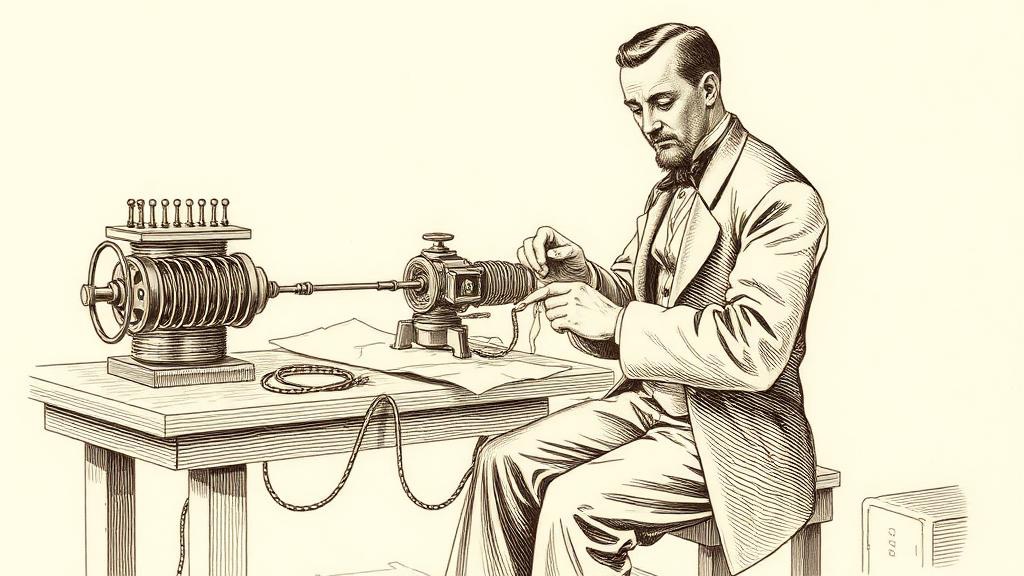
The undertaker who put telephone operators out of a job
On the morning of November 3, 1892, the telephone exchange in La Porte, Indiana connected its first call without an operator. Nobody swore at a switchboard girl, nobody waited three rings for a drowsy teenager to plug in a jack. The call went through in seconds, routed by a mechanism the size of a hatbox, invented by an undertaker who had decided, three years earlier, that human beings were an unacceptable bottleneck.
Almon Brown Strowger was one of two undertakers in Kansas City in the late 1880s, and someone was stealing his business. His competitor’s wife worked the local telephone exchange, and Strowger became convinced she was redirecting calls meant for his funeral parlor to her husband instead. The telephone company’s response was, essentially, nothing. So Strowger — a former schoolteacher with access to hat pins, magnets, and a spectacular grievance — built himself an exchange that didn’t need one.
By 1888 he had a working prototype assembled from hat pins and electromagnets, capable of routing a call to any of a hundred destinations without a single operator’s hand on the connection (SPARK Museum). U.S. Patent No. 447,918 followed on March 10, 1891. The La Porte exchange — the first automatic central switching facility in the world — opened the following November with roughly 75 subscribers.
The mechanism was elegant by the standards of a man who thought in hat pins. Each subscriber dialing sent electrical pulses down the wire. The first sequence drove the switch arm upward along a vertical shaft — ten rows, one step per pulse. The second sequence rotated it horizontally across ten contacts. First row, third column: ring subscriber thirteen. Stages could be cascaded, which meant the system scaled without redesign. No operator to misplace a call, no delay while she worked her way through a crowded board.
Strowger’s marketing literature was apparently as annoyed at telephone operators as he was. The new exchange was promoted as the “girl-less, cuss-less, out-of-order-less, wait-less telephone” — four criticisms compressed into five words (Wikipedia). A Bell manager later recalled that Strowger had vowed to “get even” with operators and “put every last one of them out of a job.” For a man professionally acquainted with endings, he had unusually vivid ambitions for the living.
The human operator had been, until then, an irreplaceable cog: the directory, the router, and the error-corrector all at once. What the Strowger switch proved was that call routing was a mechanical problem, not a human one — that the logic connecting caller A to subscriber B could be encoded in metal and repeated at scale without salary or shift changes. The step-by-step architecture was modular by design: when a city grew, you added stages rather than rebuilding the exchange. Within two decades, Strowger-style exchanges were operating across Europe and the United States.
Strowger switches stayed in service long enough to connect calls he had no vocabulary for: international dialed calls, modem handshakes, fax tones. The last British exchange using his step-by-step mechanism was switched off in 1995 — more than a century after that hat-pin prototype in Kansas City.
Sources
- Strowger switch — Wikipedia — Mechanical design, U.S. Patent No. 447,918 (March 10, 1891), La Porte exchange opening, “girl-less” marketing slogan, Bell manager quote.
- Almon B. Strowger — SPARK Museum of Electrical Invention — Kansas City rivalry backstory, hat pin and electromagnet prototype, La Porte exchange (November 3, 1892, ~75 subscribers).