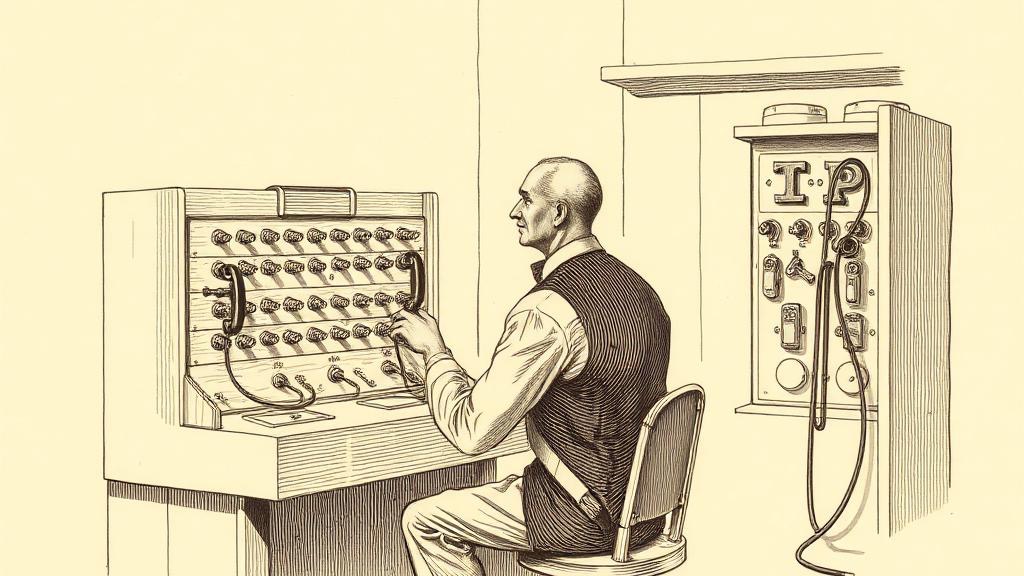
The New Haven exchange, or how a switchboard made from teapot lids wired a city
On January 28, 1878, in a rented storefront at the corner of Chapel and State Streets in New Haven, Connecticut, a Civil War veteran named George Coy sat down at a device he had built from carriage bolts, teapot-lid handles, and whatever spare hardware he could scavenge. He had twenty-one customers, each paying $1.50 a month. When any of them lifted their receiver and asked to speak to one of the others, Coy would manually patch the connection. The telephone had been alive for not quite two years, and already someone was charging for it.
Coy had not arrived here by accident. On April 27, 1877, he attended a lecture by Alexander Graham Bell at the Skiff Opera House in New Haven. Bell demonstrated a live three-way connection linking New Haven, Hartford, and Middletown, and mentioned, almost in passing, that a central exchange could let any subscriber reach any other through a single line. Coy went home convinced. He recruited two partners — Herrick Frost and Walter Lewis — secured a franchise from Bell’s company, found backers, and signed a lease. Nine months after the lecture, he opened for business.
The switchboard he built was not what you would call an engineering triumph on paper. A later account described it as assembled from “carriage bolts, handles from teapot lids, and bustle wire”. The entire office, switchboard included, was reportedly worth less than forty dollars. But it worked: the board could accommodate up to sixty-four subscribers, and when a caller wanted a connection, Coy’s operator would throw six physical switches to complete the circuit. Only two conversations could happen simultaneously. It was, in technical terms, a very small routing table made of salvaged hardware.
Twenty-one subscribers became fifty within a month. On February 21, 1878 — twenty-four days after opening — the District Telephone Company of New Haven printed the world’s first telephone directory. It was a single sheet of paper listing fifty names and businesses. Physicians and police featured prominently, which tells you something about who in 1878 felt most urgently that they needed to speak to someone at a moment’s notice. Coy’s own name appeared on the list, along with Frost’s and Lewis’s. Only two copies of that sheet are now known to survive; one lives in the archives of the University of Connecticut Libraries.
What the New Haven exchange proved was something Bell had articulated but nobody had yet built: that the value of a telephone is not the device but the network. Before Coy’s switchboard, a telephone was a leased pair — two phones, one wire, one conversation. After it, any subscriber with one phone could reach any other subscriber through the central office. The cost of adding a new member to the network dropped to the cost of a single wire to the exchange. That topology — hub and spoke, everything routed through a shared center — is still how most of global telephony works, from copper to LTE.
By 1882, the District Telephone Company had grown into the Southern New England Telephone Company and held rights to serve all of Connecticut. The teapot-lid switchboard was long gone. But the question it first answered — how do you let one phone reach any phone? — is still the question every telephone network in the world is answering.
Sources
- Connecticut History — First Commercial Telephone Exchange — Date, founders, subscriber count, franchise history, growth to SNET.
- New England Historical Society — George Coy — Coy’s background, Bell lecture inspiration, switchboard construction and operation.
- UConn Libraries — World’s First Telephone Directory — The February 21, 1878 directory, surviving copies held at UConn Archives.