Bell's telephone, or how nine words traveled down a wire
On the morning of March 10, 1876, Alexander Graham Bell spilled sulfuric acid on his clothes in his Boston laboratory. He picked up a membrane-and-wire contraption he had been tinkering with for months and called through it to the next room: “Mr. Watson — come here — I want to see you.” According to Watson’s later account, the words came through clearly. Watson came. The telephone had made its first call.
Bell was twenty-nine years old, a professor of vocal physiology at Boston University, and the son of a man who had spent his career teaching the deaf to speak. Three days earlier — on March 7, 1876 — he had received US Patent 174,465 for “the method of, and apparatus for, transmitting vocal or other sounds telegraphically.” With some irony, the patent had been issued before Bell actually had a working telephone. He fixed that on March 10.
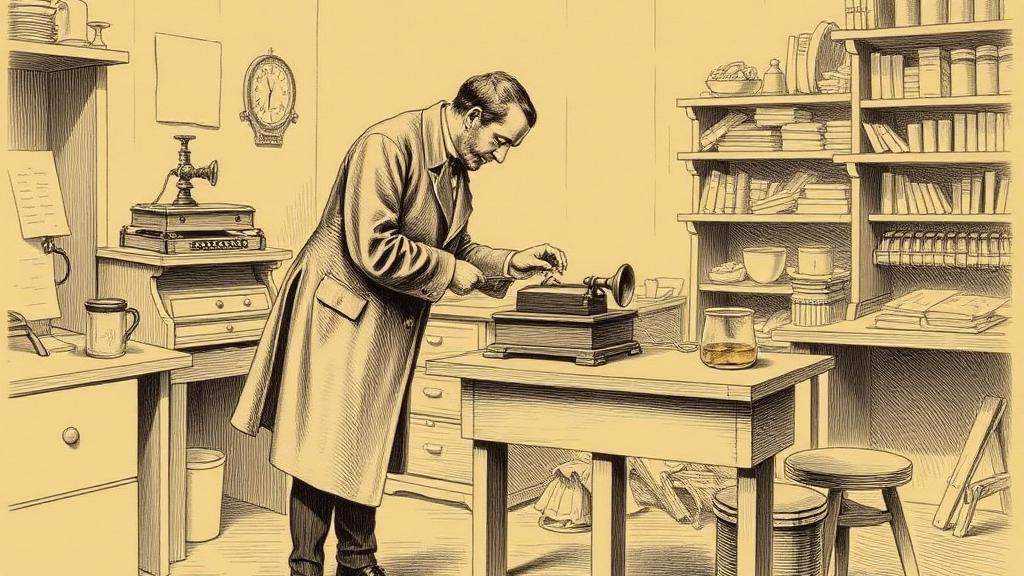
The machine on his workbench at 5 Exeter Place, Boston was not what anyone would call elegant. Bell used a liquid transmitter: a cup of acidified water, a needle dangling from a parchment diaphragm. When he spoke, the diaphragm vibrated, the needle bobbed in the acid, and the varying resistance sent a fluctuating current down the wire to Watson’s receiver in the adjacent room. One could reasonably ask where Bell got the idea for a liquid transmitter. The answer is uncomfortable: from Elisha Gray, his rival, who had included an almost identical design in a patent caveat filed to the Washington Patent Office on February 14, 1876 — hours after Bell’s own application arrived that morning.
That coincidence of hours has filled law books ever since. Gray’s lawyer arrived that afternoon; Bell’s agent had filed that morning. The patent examiner ruled in Bell’s favor. Gray spent years in court alleging that Bell’s backers had accessed his confidential caveat and lifted its key innovation. Bell denied it; a 2020 paper in IEEE Proceedings re-examined the archive and came down, guardedly, on Bell’s side. But in a letter of March 2, 1877, Bell himself admitted to Gray that he had known Gray’s caveat “had something to do with the vibration of a wire in water” — the very breakthrough that made March 10 possible.
Whether Bell invented the telephone or merely arrived at the Patent Office first has generated more litigation than it initially made in revenue. What is not in dispute is what followed. The Bell Telephone Company incorporated in 1877. By 1886, 130,000 telephones were in service across the United States. A network that had not existed a decade earlier had become indispensable to banks, newspapers, and city governments almost overnight.
At the 1876 Centennial Exhibition in Philadelphia, Dom Pedro II, Emperor of Brazil, came to Bell’s exhibit expecting nothing in particular. He picked up the receiver, heard Bell’s voice from fifty feet away, and — as the press reported it — exclaimed, “My God, it talks.” He nearly dropped the thing. Bell took careful note: what the world needed was a demonstration, not a filing.
The telephone that crossed that room in Boston has crossed every room since.
Sources
- Science Museum, London — “Ahoy! Alexander Graham Bell and the first telephone call” — device mechanics, patent timeline, 130,000 phones by 1886, the communications revolution
- The Conversation — “The story of the first telephone call: nine words that changed the world” — Watson’s account, exact words, Bell-Gray rivalry, Dom Pedro II anecdote
- Elisha Gray and Alexander Bell telephone controversy — Wikipedia — parallel February 14 filings, patent dispute history, Bell’s 1877 letter to Gray