The wheel that replaced the operator
The three-button telephone that arrived in subscribers’ homes after the La Porte exchange opened in 1892 was, technically, automatic. Nobody needed to flag down an operator. But placing a call still required knowing, every time you picked up the handset, exactly how many times to press each button. Calling number 36 meant three taps on the tens button, then six on the units button, in that order. Miscounting got you the wrong party. There was no retry without repeating the whole ritual. The human operator had been removed from the circuit. The problem had simply been handed to the caller.
That problem took a quarter-century to solve properly.
By 1896, engineers at the Automatic Electric Company — the firm that had absorbed Strowger’s patents and was supplying his exchange design to the independent telephone market — had patented a rotating finger-wheel to replace the buttons. A caller placed a finger against the appropriate lug on the wheel, rotated until a mechanical stop caught it, and released. A spring drove the wheel back to its resting position, and on that return journey a ratchet mechanism counted pulses — one per notch — sending them down the wire to the exchange. Dial six: six pulses. Dial nine: nine. The central switch stepped to the right contact. The logic was sound; the raised lugs were hard to operate with confidence, and subscribers frequently sent the wrong count.
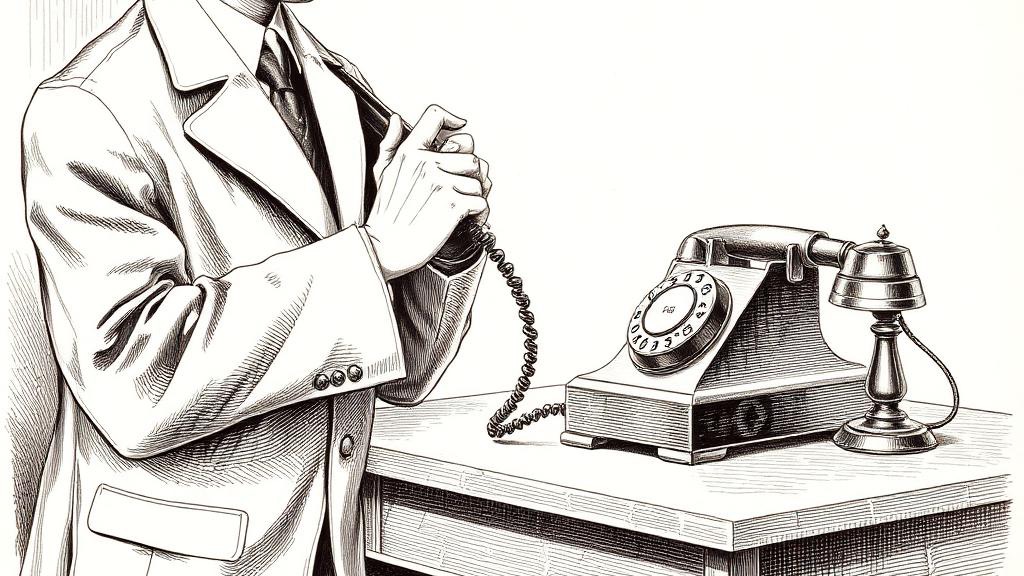
The refinement that settled the matter came around 1907: ten numbered apertures punched cleanly into a rotating wheel, each sized and spaced so that inserting a finger and turning to the stop produced an unambiguous pulse count. A mechanical governor on the return spring kept the dial’s speed consistent — too fast and the exchange missed pulses; too slow and calls stacked up. Operators of the independent telephone companies had been living with Strowger-style exchanges for fifteen years; their subscribers learned the finger-hole dial in an afternoon.
Bell Telephone, which served most of the country’s urban subscribers, was still connecting calls by operator. In 1916, Bell’s manufacturing arm acquired Strowger’s patents for $2.5 million, a purchase that confirmed the technology’s future without immediately changing anyone’s service. Three years later, Western Electric produced the Model 50AL: the first Bell System dial telephone, a candlestick-style handset with the finger-hole dial mounted at the base of its upright stem, manufactured from 1919 to 1928 (Telephone Archive). In 1921, Norfolk, Virginia became the first Bell city to route its calls through machine switching rather than an operator’s hands.
The national rollout was deliberate. Bell’s operator workforce numbered in the hundreds of thousands, and every exchange building required new central switching equipment before a single subscriber could dial. But the direction was set, and by the late 1920s the finger-hole rotary dial had moved from the independent lines to the American standard.
What the dial settled was more than a mechanical argument. Before it, placing a telephone call was a social transaction: you spoke to a human intermediary, gave a name or a number, and waited for her judgment and her memory to complete the connection. The operator knew who you were calling. The dial made the transaction private — you turned a wheel, the machine stepped through the exchange, and nobody intercepted the setup.
The dial went out of production in the 1980s. The word it gave us has not.
Sources
- Rotary dial — Wikipedia — Evolution from push-button to finger-wheel (1896) to finger-hole design (~1907); Bell System adoption timeline (early 1920s).
- Western Electric 50AL — Telephone Archive — First Bell System dial telephone (1919–1928); Norfolk, Virginia as inaugural Bell dial city (1921).
- La Porte dial network — Light Brigade — Bell’s $2.5 million acquisition of Strowger’s patents in 1916.