The incense clock, or how China measured the night in smoke
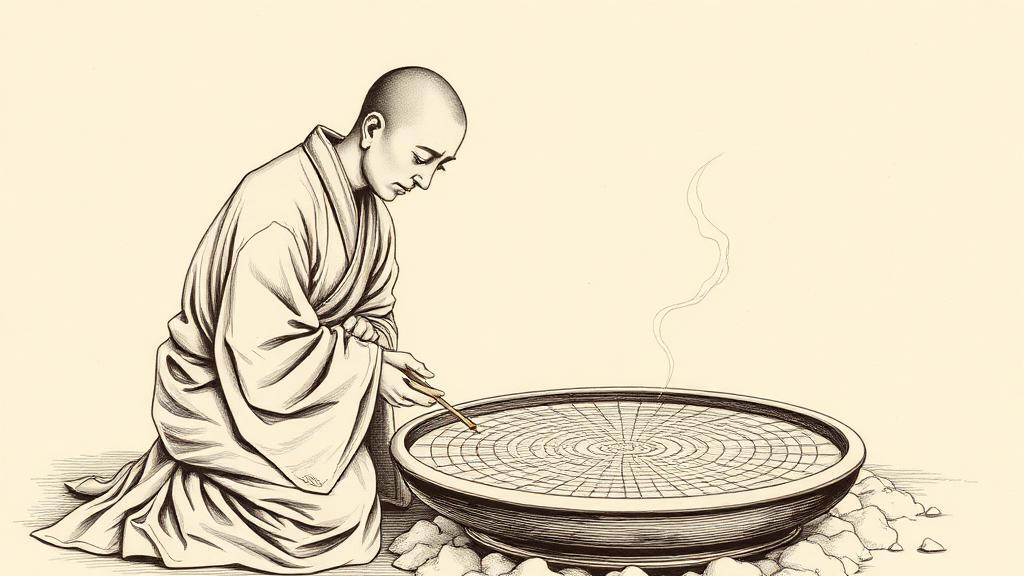
A Buddhist monk in Liang-dynasty China, around 520 CE, pressed powdered incense into the grooves of a maze-cut seal, smoothed white wood ash into a bronze tray, and lit the starting edge. He had just set time on fire.
The Chinese court poet Yu Jianwu, writing in the early sixth century, described a burning incense seal measuring the hours — giving us our first fixed date for the practice. The device had no gears, no water, no moving parts. Just a burning line advancing through a maze, and the maze was the clock.
The body was a shallow censer, usually bronze or lacquered wood, built in three layers: a bottom tray holding tools (a tiny shovel, a damper, a set of seasonal stencils), a middle tray of packed white ash, and a perforated lid to vent the smoke without disturbing the burn. The operator selected a stencil — different mazes cut for different seasons, because the makers understood that the hours of daylight shifted across the year — and traced incense powder through the channels. The ember crept at a calibrated rate. Small markers placed along the path divided the intervals. A stick version threaded fine cords with small metal weights around the incense at measured intervals; when the burn reached each knot, the thread parted and the weight fell into a brass basin with a ring. You could sleep through a sundial, but probably not through that.
During the Song dynasty (960–1279), the designs grew more elaborate. A dragon-shaped alarm version ran bells on threads above a horizontal burning stick, dropping them at preset intervals. Other makers loaded different varieties of incense at different points in the maze — agarwood, then sandalwood, then something sharper near dawn — so the night moved not only in light and sound but in fragrance (JSTOR Daily).
In Edo-period Japan, geishas were paid not by the hour but by the number of senko-dokei — incense clocks — consumed while they were present (Wikipedia). The device sat in the corner of the room, silent and fragrant. A guest did not check his watch; he watched a curl of smoke thin and disappear. The practice continued, in some establishments, until 1924.
No water clock could match it for simplicity. Clepsydras needed level ground, unfrozen water, and someone to refill them. Sundials required sun. The incense clock needed only a spark and a windless room, and it burned through the night, through the rain, through every circumstance a court official or a temple monk or a coal miner might encounter. By the time Europe’s mechanical escapement arrived in the late 13th century, the incense clock had already kept the hours of Chinese temples and teahouses for seven hundred years. Gears and pendulums would eventually surpass it — but first, someone had to prove that time could be measured by something consuming itself at a steady rate.
Sources
- Incense clock — Wikipedia — First use in 6th-century China, Yu Jianwu, mechanics of powdered and stick varieties, Song dynasty innovations, Japanese senko-dokei practice.
- Keeping Time with Incense Clocks — JSTOR Daily — Mechanics in detail, dragon alarm variant, geisha payment practice, use into the 20th century.