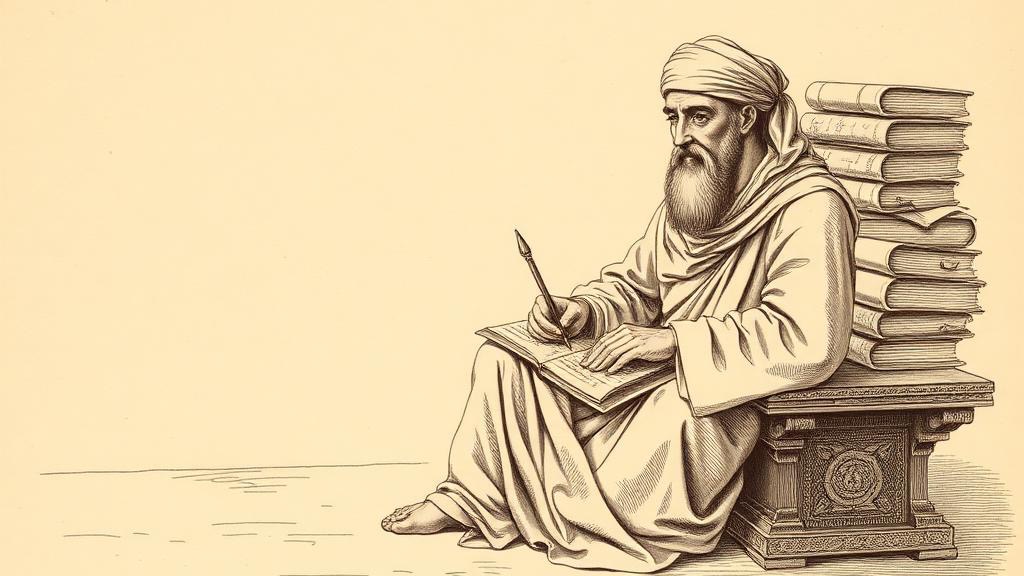
Al-Khwarizmi, or how a name became a word
Somewhere in the 12th century, a Latin scribe copying an Arabic mathematics manuscript wrote down the author’s name as best he could render it: Algoritmi. He was just transliterating. He had no idea he was coining a word that would still be in daily use nine centuries later, inside every search engine and recommendation system on earth.
Muhammad ibn Musa al-Khwarizmi was born around 780, probably in the region of Khwarizm — a stretch of Central Asia south of the Aral Sea — and by his thirties had made his way to Baghdad (MacTutor). There, under Caliph al-Ma’mun, who reigned from 813 to 833 CE, he worked at the House of Wisdom: a translation academy and research institution dedicated to systematically importing the intellectual inheritance of the ancient world — Greek geometry, Indian astronomy, Persian scholarship. Al-Khwarizmi was not a passive translator. He was one of the people pushing that inheritance forward.
Around 820 he finished a book. Its full Arabic title is Hisab al-jabr w’al-muqabala — roughly, The Compendious Book on Calculation by Completion and Balancing (Britannica). Al-jabr, “completion”: the operation of moving a negative term to the other side of an equation to make it positive. Through 12th-century Latin translation, al-jabr became algebra. Al-Khwarizmi was explicit about what the book was for — not an abstract treatise for fellow scholars, but a practical manual for solving problems of “inheritance, legacies, partition, lawsuits, and trade.” The first systematic algebra textbook in history was drafted as a reference for judges dividing estates.
His second major work explained the Hindu decimal numeral system — the nine digits and a zero that the Arab world had adopted from Indian mathematics. The original Arabic has not survived. What remains is a 12th-century Latin translation titled Algoritmi de numero Indorum: “Al-Khwarizmi on the Hindu art of reckoning.” The Latinized name drifted. Algoritmi became algorismus, then algorism, then algorithm — a step-by-step procedure, precisely specified and repeatable, that yields the same result for the same input every time (MacTutor). He was just explaining place-value arithmetic. It turned out to be the most consequential explanation in the history of computing.
The detail worth sitting with is the literal meaning of al-jabr. In classical Arabic the word described a surgical procedure: the setting of broken bones, the rejoining of what had been separated. A negative term moved across the equals sign is, in al-Khwarizmi’s implicit metaphor, a fracture being reduced. Mathematics as orthopaedics is not an image you expect to find at the root of computer science, but there it is.
What al-Khwarizmi handed to the future was a two-part gift. Algebra gave Western mathematics a language for describing unknown quantities and transforming them through defined rules — the grammar that underpins every equation a programmer has written since. And the algorithm gave it something stranger: a procedure so precisely specified that it can be carried out by someone — or something — with no understanding of why it works. The abacus had externalized arithmetic. Al-Khwarizmi externalized the reasoning.
Eight centuries later, Ada Lovelace would write instructions for a machine that couldn’t understand them either.
Sources
- Al-Khwarizmi — MacTutor History of Mathematics, University of St Andrews — dates, biography, House of Wisdom context, both major works, etymology of “algorithm” from the Latinized name.
- Al-Khwarizmi — Encyclopaedia Britannica — title and scope of the algebra treatise, the Hindu-Arabic numerals book, significance for European mathematics.