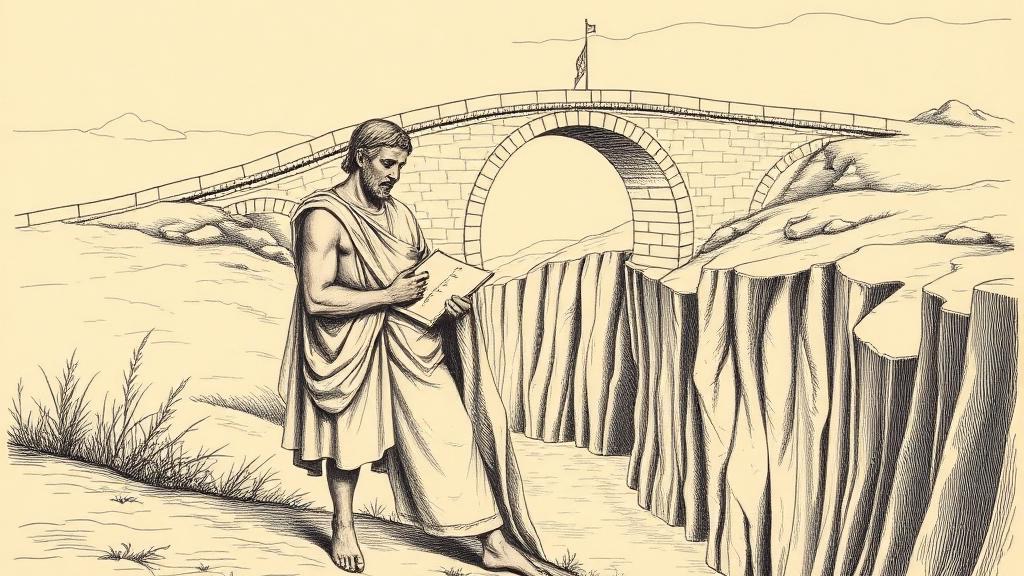
The Pont du Gard, or how Rome moved a river across a gorge
At some point around 50 CE, a Roman engineer stood on the bank of the Gard River in southern France and faced a problem that would have stopped most of his predecessors. The springs at Uzès lay 50 kilometres to the north-east, their water only slightly higher than the city of Nîmes that needed it. In between: hills, valleys, and a limestone gorge nearly 50 metres deep. The water had to get across.
The Pont du Gard was the answer — three tiers of stone arches above the gorge. Standing 48.8 metres high and spanning 274 metres, it begins at the riverbed: six great lower arches, some 24 metres wide, their feet planted directly in the current. Eleven middle arches stack above those. At the top, 35 smaller arches carry the water channel itself, a covered stone conduit barely wide enough for a man to stand upright. No mortar held any of it together. The limestone blocks — quarried from Estel about 700 metres downstream, some weighing six tonnes — were cut to fit by friction and gravity alone. Assembly marks carved into the stones, notches and letters telling each worker exactly where each block belonged, survive to this day.
The gradient is what engineers still find unsettling. Across the aqueduct’s full 50 kilometres, the channel drops at an average of 1 in 3,000 — about 34 centimetres per kilometre. In one particularly demanding section, the surveyors held it to 7 millimetres per 100 metres. They accomplished this with a groma for sighting lines and a chorobates for levelling — essentially a long spirit level — recording their figures on wax tablets. No GPS. No second chances; a miscalculation meant pooling, and pooling meant the whole enterprise stopped. When it worked, the system delivered 40,000 cubic metres of water a day to the fountains and baths of Nîmes. Roughly 800 to 1,000 men spent about fifteen years building it, according to modern analysis by historian Guilhem Fabre.
In 1738, Jean-Jacques Rousseau walked out onto the bridge and stopped. He later wrote that he stood there, seized and silent, imagining “the strong voices of those who had built them.” He was 26, not yet the philosopher who would reshape European thought, just a young man from Geneva confronting something that still produces the same effect: the faint vertigo of a thing that should not, by any reasonable measure, still be here.
The aqueduct silted and stopped flowing around the 6th century as Roman administration withdrew from the province. Medieval lords turned the lower tier into a toll bridge. In the 1620s a local duke had part of the second tier cut away to widen the road for artillery; the structure survived, barely. Major restoration work followed in 1743 and again in 1855, the second prompted by an official inspection that found the stonework in what the report called “terrible” condition.
The Pont du Gard did not invent the arch. It did not invent aqueducts. What it settled — for anyone willing to calculate — is that water will travel remarkable distances if you simply refuse to lose any elevation you don’t have to. The water stopped in the 6th century. The arithmetic behind it has been running ever since.
Sources
- Pont du Gard — Wikipedia — construction period, dimensions, gradient figures, mortar-free technique, Rousseau visit, Guilhem Fabre’s dating, post-Roman history.
- Pont du Gard — UNESCO World Heritage Centre — average gradient of 1 in 3,000, water volume delivered daily, inscription context.
- 40 centuries of history — pontdugard.fr — construction timeline, post-Roman use as toll bridge, the 1620s damage and subsequent restorations.