Fort Rock sandals, the oldest shoes in the world
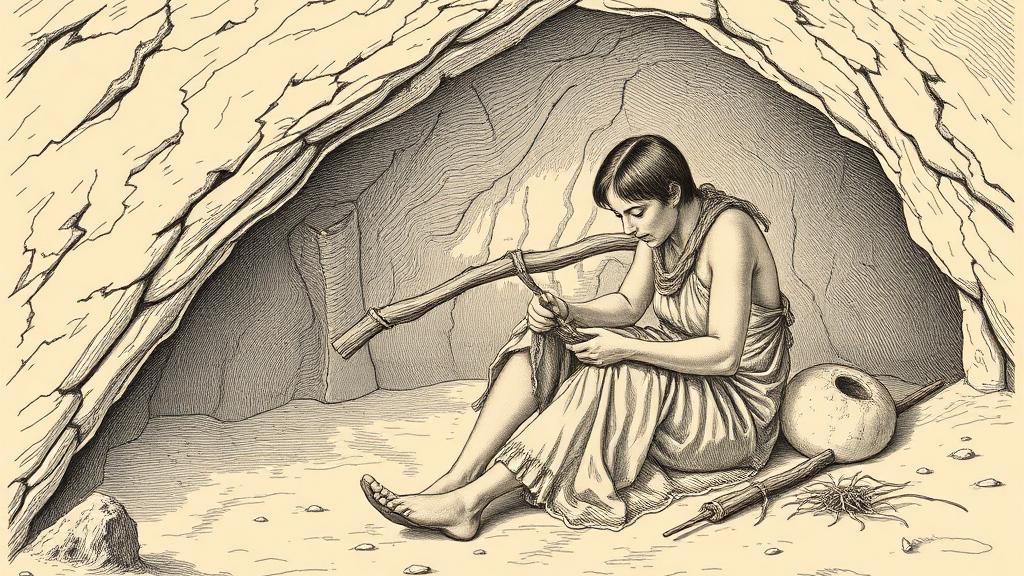
Somewhere in the high desert of central Oregon, roughly ten thousand years ago, someone sat down with a bundle of sagebrush bark and wove a pair of sandals. The work was careful: five rope warps running heel to toe, the wefts twisted in pairs around each strand in a tight spiral, then subdivided near the front and folded back to form a flap over the toes. Some makers went further and added diagonal twining in decorative patterns. The sandals fit. They were worn. They were set down inside a cave and forgotten, until a volcano buried them.
That volcano was Mount Mazama. Its catastrophic eruption approximately 7,600 years ago scattered ash across a vast swath of the Pacific Northwest and left behind the caldera we now call Crater Lake. The same ash sealed an accidental archive inside Fort Rock Cave — a natural shelter carved by ancient wave action into a volcanic butte in Lake County, Oregon. When University of Oregon anthropologist Luther Cressman excavated there in 1938, he and his team pulled ninety-five sandals and sandal fragments from the sediment below that ash layer. Cressman knew immediately they were old. He just couldn’t prove it yet.
Radiocarbon dating didn’t exist in 1938. To prevent the sandals from crumbling, Cressman treated them with chemical preservatives — which had the unintended effect of making them undatable by the new technique. It would take unpreserved specimens from other Great Basin sites, plus more than a decade’s wait for dating technology to mature, before the numbers came in. When they did, around 1951, the result was more than 9,000 years old. Subsequent analysis using updated techniques pushed the range to at least 10,500 years before present — putting the earliest examples around 8500 BCE. The Fort Rock sandals are the oldest directly dated footwear ever found.
The construction is worth pausing on. This was not a flat piece of bark lashed to a foot. The twining technique — weft pairs twisted around each other as they encircle each warp strand — is the same structural principle used in sophisticated basketry. The soles were close-twined for durability; the toe flap open-twined for flexibility. Some specimens display what archaeologists call false embroidery, a decorative technique with no structural function at all. Someone was making shoes that looked good, not just shoes that worked.
The same Fort Rock style has been identified at Cougar Mountain and Catlow Caves nearby. Klamath and Paiute peoples of the region were still weaving sagebrush-bark sandals by similar methods when 19th-century ethnographers first documented the tradition — a ten-thousand-year-old hand skill, passed along until the notebooks finally caught up with it.
What the Fort Rock sandals establish is simple but significant: within the entire span of human prehistory we can currently date, the oldest footwear we have is already technically accomplished, regionally distributed, and partly ornamental. There was no fumbling prototype stage visible in the record. Someone had figured this out long before Cressman arrived with a trowel.
The ground has always been a problem worth solving.
Sources
- Fort Rock Cave — Wikipedia — discovery details, sandal count (95 specimens), chemical preservative complication, dating history, significance as oldest footwear.
- Fort Rock Sandals — University of Oregon (Connolly) — radiocarbon dating range (10,500–9,200 BP), construction technique, warp count, toe-flap structure.
- Fort Rock Sandals — Oregon Encyclopedia — materials, twining method, cultural continuity into Klamath and Paiute traditions, regional distribution across Great Basin sites.