The last Olympiad, 393 CE
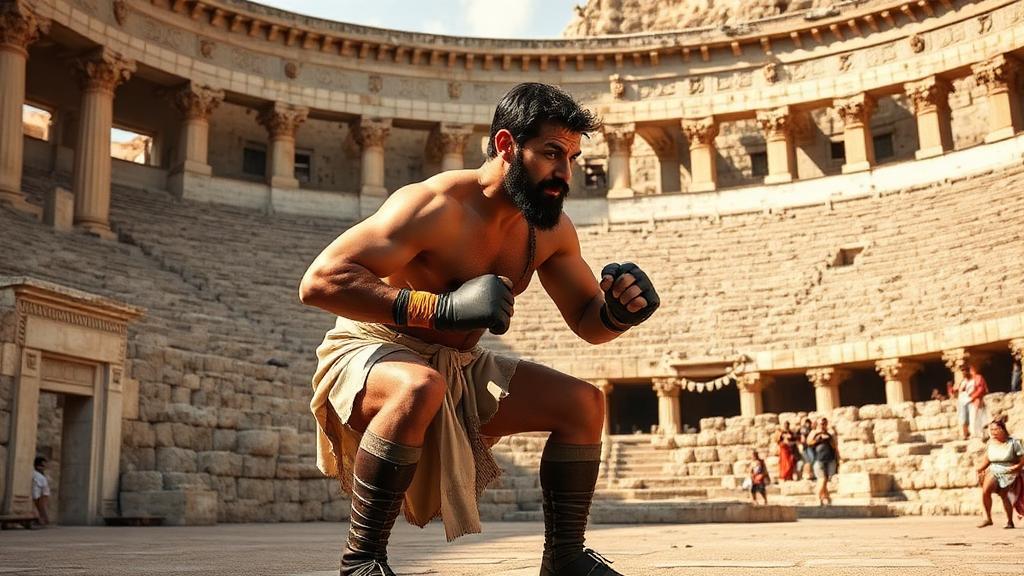
The last named champion of the ancient Olympic Games was an Armenian. Varazdat, heir to the Arsacid throne of Greater Armenia, won the boxing event at the 291st Olympiad — around 385 CE — and his victory appears in the chronicle of Eusebius of Caesarea, who recorded the Games’ final decades. In 1994, excavators at Olympia recovered a bronze plaque confirming that competition had continued into that period. Eight years after Varazdat’s win, the Games were gone.
The man who ended them was Theodosius I, emperor of a Rome that had been Christian in name for six decades and was becoming Christian in law. Between 389 and 393, the Theodosian edicts banned temple visits, abolished the remaining pagan holidays, and established Nicene Christianity as the official religion of the empire. The Olympic Games — held every four years in honor of Zeus since 776 BCE — were not a borderline case. They began with animal sacrifice. They ran under the gaze of Pheidias’s chryselephantine Zeus, forty feet tall, counted among the Seven Wonders of the ancient world, and every competitor arrived at a site that had functioned as a sanctuary for longer than Rome had existed as a city. To attend was to participate in a religious ceremony honoring a god the emperor had just outlawed.
The Games had run for 1,169 years across 293 consecutive Olympiads, through the Persian Wars, the rise and fall of Alexander, and Rome’s long absorption of the Greek world. By the late fourth century they were changed — professional athletes competed across multiple festivals rather than citizen-soldiers proving themselves to their city-states — but they were still running. The 293rd Olympiad in 393 CE was the last. Theodosius’s general prohibition on pagan cult practice ended them without any decree that named the Games specifically.
The erasure of the physical site was slower, but thorough. Theodosius II — grandson of the first — ordered the remaining buildings demolished around 426 CE. Pheidias’s workshop, where the great Zeus had been assembled two centuries before Christ, was converted into a Christian basilica. A small community settled at the ruins through the fifth century, until Justinian’s plague arrived. Then two earthquakes — in 522 and 551 CE — shook the Peloponnese. The Alpheios and Kladeos rivers flooded repeatedly, and Mount Kronios shed its slopes. Within a few generations, the entire sanctuary of Olympia lay buried under meters of mud and sand, invisible for roughly 1,200 years.
The end of the ancient Olympics was not just the cancellation of a festival. It was the closure of the only institution that had required the Mediterranean world, for more than a millennium, to agree on a shared set of rules — who was eligible, what was permitted, when the truce held.
Pierre de Coubertin revived the Games in Athens in 1896, 1,503 years after Theodosius ended them. The bronze plaque confirming the last ancient Olympiad was found ninety-eight years later.
Sources
- Ancient Olympic Games — Wikipedia — duration (776 BCE–393 CE), 293 Olympiads, Varazdat as last known champion, the 1994 bronze plaque, fate of the Olympia sanctuary after the ban.
- Ancient Olympic Games — World History Encyclopedia — the 293rd Olympiad and Theodosius I’s decree banning all pagan cult practice.
- Varazdat — Wikipedia — Armenian prince, boxer, 291st Olympiad (~385 CE), recorded in the chronicle of Eusebius of Caesarea.
- Persecution of pagans under Theodosius I — Wikipedia — Theodosian edicts of 389–393 CE banning temples, pagan holidays, and establishing Christianity as state religion.