The Mother of All Demos, or the ninety minutes nobody was quite ready for
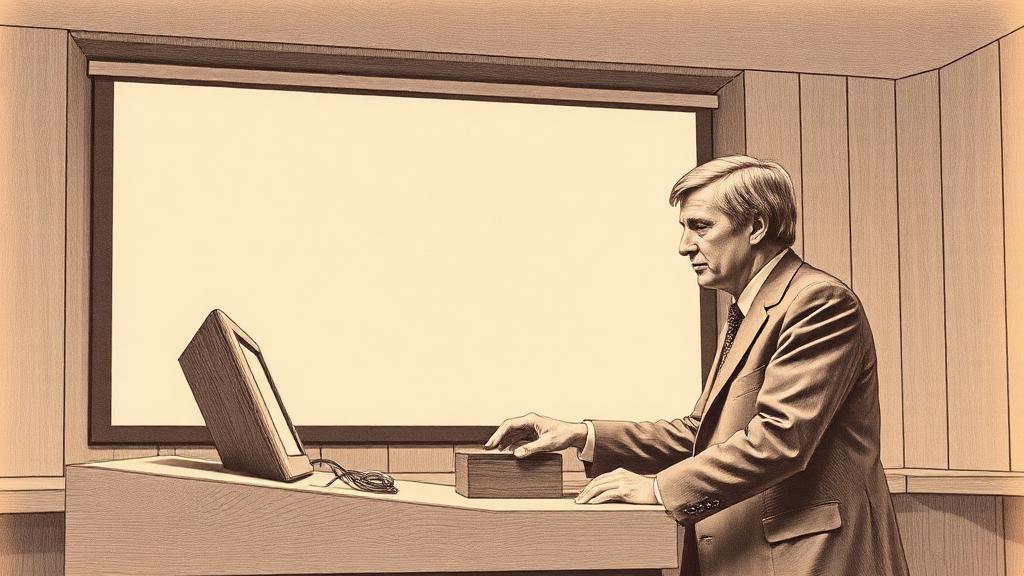
It had a cord that looked like a tail, which is why Douglas Engelbart called it the mouse. It was a small wooden box with a single button, built by his colleague Bill English from rough sketches — and when Engelbart moved it across the desk in San Francisco’s Civic Auditorium on December 9, 1968, a cursor moved on the screen overhead. The roughly thousand computer scientists in the audience were watching something for which, in 1968, there was no name.
Engelbart was 43, an engineer at the Stanford Research Institute in Menlo Park, running a team he called the Augmentation Research Center. His central question — the one he had carried since reading Vannevar Bush’s 1945 essay “As We May Think” while serving as a Navy radar technician in the Philippines — was whether technology could amplify human thought rather than simply replace human labor (Wikipedia). The abacus had moved arithmetic from the head to the hand. Engelbart wanted to move something larger: the whole collaborative management of ideas.
NLS — the oN-Line System — was what that looked like when built. It ran on an SDS-940 computer back in Menlo Park, connected to the auditorium by dual modems running at 1200 baud. Over ninety minutes, Engelbart used it to show multiple windows, hypertext links, shared documents edited by two people in real time, and video teleconference panels embedded in the same interface as the text. A complete, integrated system for knowledge work — not a prototype, a daily working environment.
None of it had been shown publicly before, not as a coherent whole.
The production was itself a feat. English stayed in Menlo Park, operating equipment and co-presenting via the video link. Stewart Brand — then best known as editor of the Whole Earth Catalog — ran the camera at SRI. Engelbart had used NLS daily for years, refining it while working in it (Doug Engelbart Institute). The logic was deliberate: you cannot prototype collaborative tools in isolation.
The audience gave him a standing ovation. Before the session began, many had considered him something of a crank. Andy van Dam, a Brown University computer scientist who had been working on his own hypertext project, practically accosted Engelbart at the end to tell him how far ahead he was (Wikipedia). Someone in the crowd described Engelbart at the console as “dealing lightning with both hands.”
Nothing shipped immediately. The vision was too complete, the infrastructure too scarce. But within a few years, much of the team — including Bill English — moved to Xerox PARC, where their ideas became the Alto, the first personal workstation with a mouse and a graphical interface. Steve Jobs saw the Alto demonstrated in December 1979. Five years later came the Macintosh.
The session title in the conference program read: “A Research Center for Augmenting Human Intellect.” The name “Mother of All Demos” arrived retroactively. On that December morning in 1968, it was just a ninety-minute slot in San Francisco — and the cursor on the screen was sliding somewhere no cursor had been before.
Sources
- The Mother of All Demos — Wikipedia — event date and venue, NLS system details, audience reaction, Andy van Dam’s encounter with Engelbart, trajectory to Xerox PARC, origin of the name.
- Doug Engelbart Institute — The Demo — remote setup from Menlo Park, Bill English’s engineering role, the daily-use bootstrap philosophy, preparation approach.