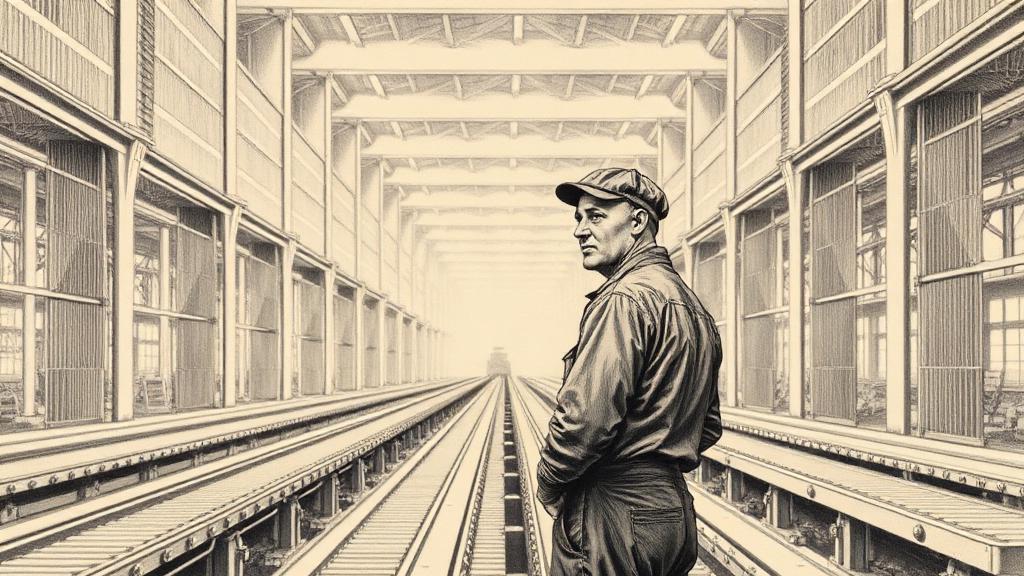
Ford's moving assembly line: 12.5 hours to 93 minutes
On April 1, 1913, in a section of Ford’s Highland Park plant devoted to assembling flywheel magnetos, a line of workers stood still and let the work come to them. Before that morning, one man sat at a bench and built each magneto himself — 29 operations, about 20 minutes apiece. Now 29 workers each handled one operation and slid the part along to the next. Time per unit: 13 minutes. After adjusting the platform height and the pace of the slide: five minutes.
Ford’s production chief Charles Sorensen and his assistant Clarence Avery noted the numbers and started measuring everything else. Highland Park had been Ford’s flagship since it opened in January 1910: a four-story reinforced-concrete factory designed by Albert Kahn on Woodward Avenue, just north of Detroit, built to manufacture the Model T at a scale no one had previously attempted. Overhead cranes, specialized machine tools, a layout funneling parts toward final assembly — the plant already had all of it. What it lacked was momentum.
That problem had an answer by October 7, 1913. Sorensen and Avery stationed 140 assemblers along a 150-foot chassis line and set the work moving — but not before solving the mechanics the hard way. They had tried pulling multiple chassis simultaneously with ropes, different gauges, attached to ten or more frames at a time. Each rope snapped. They switched to chain.
The idea was borrowed, without embarrassment, from Chicago’s meatpacking plants, where pig and cattle carcasses had been moving past stationary butchers on overhead trolleys since at least the 1860s. Ford later acknowledged the debt. The Highland Park line ran the same logic in reverse: instead of systematically disassembling an animal, it systematically assembled a car.
The numbers tell the rest. Chassis assembly time before the moving line: 12.5 hours. After October 7: six hours. By the end of 1914, with Avery’s time-and-motion studies still finding minutes to remove: 93 minutes. Output at Highland Park climbed from hundreds of cars a day to thousands. The Model T, already the cheapest automobile on the American market, fell from $850 at its 1908 launch to $360 by 1916 and kept going.
In January 1914 — three months after the chassis line went live — Ford raised the minimum daily wage at Highland Park to $5, more than double the going rate for factory work. The move was partly calculated: turnover on a repetitive, chain-paced line was severe, and the cost of constant retraining was eating into the gains. But Ford also understood something economists would later call Fordism: if the workers building the car could afford to buy it, some of them would. At $5 a day, the arithmetic closed.
Fifteen million Model Ts rolled out before production ended in 1927, accounting at their peak for close to half of all automobiles sold worldwide. Within a decade the moving assembly line had spread to refrigerators, radios, aircraft engines, and pharmaceutical plants. What Sorensen and Avery proved in Highland Park — that you could build a complex machine faster by keeping it moving than by letting workers walk to it — became the foundational premise of every high-volume factory that followed.
The chain got faster. Some of the stations went unmanned. The logic stayed the same.
Sources
- Magneto Assembly at the Ford Highland Park Plant, 1913 — The Henry Ford — flywheel magneto line details, April 1913 timeline, 29-operation sequence.
- Moving Assembly Line Debuts at Ford Factory — History.com — October 7, 1913 chassis line, meatpacking plant inspiration, production figures and price reductions.
- Ford Implements the Moving Assembly Line — Library of Congress — 15 million Model T count, production timing, global spread of the moving line concept.